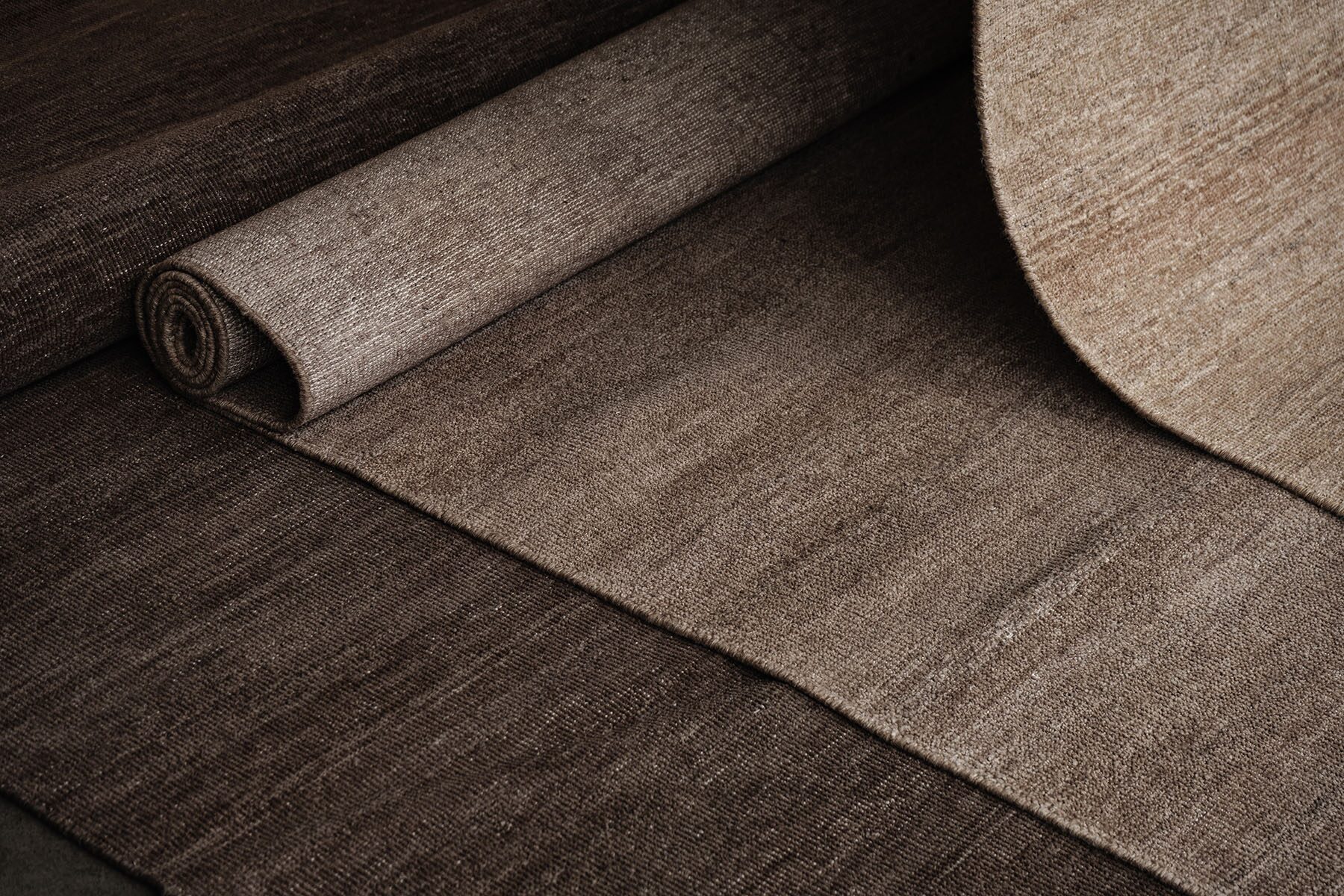
knowledge library / Wool vs. Washable Rugs: What to Choose for a Real Home
Washable rugs are appealing for an obvious reason: life is messy. Pets, children, dining chairs, entryways, and everyday spills can make a rug feel like a maintenance decision before it ever becomes a design decision. But the easiest rug to launder is not always the best rug for the room.
The better question is not whether wool rugs or washable rugs are universally better. It is what kind of use the room will see, what kind of texture and permanence you want, how much cleaning you realistically expect to do, and whether the rug needs to feel like a temporary convenience or a lasting part of the interior.
For many homes, washable rugs make sense in specific, high-spill zones. For rooms where material depth, scale, texture, and long-term design value matter more, a well-chosen wool rug often gives the space more presence.
The Short Answer
Choose a washable rug when frequent machine washing is the primary requirement and the room can accept a thinner, more casual floor covering. Choose wool when you want richer texture, better visual depth, and a rug that feels integrated into the design of the room rather than simply easy to clean.
That does not mean wool belongs everywhere. A pale, plush wool rug under a toddler's snack table may be asking too much of the material and the household. It also does not mean washable rugs are only for informal spaces. Some can be useful in apartments, kids' rooms, laundry-adjacent areas, and rooms where the rug is intentionally low-commitment.
The best choice usually depends on four questions:
- How often will the rug need to be cleaned?
- Does the room need softness, structure, texture, or pattern?
- Will the rug sit under heavy furniture, dining chairs, or rolling traffic?
- Is the rug meant to be a long-term design element or a practical layer for a season of life?
What People Mean by "Washable Rug"
"Washable rug" can describe several different products. Some are lightweight rugs that fit into a home washing machine. Some use a removable cover over a separate pad. Others are marketed as easier to spot clean but are not necessarily meant for frequent full washing.
Before buying one, read the care instructions closely. A rug may be called washable, but that does not always mean it will fit comfortably in a household machine, tolerate hot water, handle repeated laundering, or lie perfectly flat afterward. Size, fiber, backing, construction, and drying method all matter.
Washable rugs tend to be most useful when convenience is the point. They can be a practical answer for mudrooms, playrooms, small apartments, pet-heavy households, or lower-stakes rooms where easy removal matters more than heirloom materiality.
Why Wool Still Matters
Wool has remained one of the most important rug fibers because it offers a combination that is difficult to imitate: warmth, resilience, softness, texture, and visual depth. In a handwoven or hand-knotted rug, wool can hold color beautifully, support many constructions, and bring a room a sense of material seriousness.
A wool rug is not automatically right for every household or every room. Pile height, density, weave, color, age, and use all affect how it behaves. But when the goal is to anchor a living room, soften a bedroom, add texture to a study, or bring lasting character to a designed interior, wool is often the more satisfying choice.
For a contemporary room, WOVEN's contemporary rugs and STUDIO WOVEN textures show how wool and other natural fibers can become part of the architecture of a space: quiet, tactile, and intentional rather than merely decorative.
Cleaning: Convenience vs. Care
The strongest argument for a washable rug is simple: if something spills, you may be able to wash the rug or cover more easily than you could clean a traditional rug. For some households, that convenience is worth the tradeoff.
The tradeoff is that washable rugs are often lighter, thinner, and more casual in their floor presence. Depending on construction, they may shift more, show edge movement, or rely heavily on a pad system. They can solve a cleaning problem while creating a different design or placement problem.
Wool asks for a different mindset. It is not usually a machine-wash proposition, and care should follow the rug's specific construction and fiber guidance. Spills should be addressed promptly and cautiously. Larger cleaning questions, especially for handmade, antique, or delicate pieces, should go to a qualified rug cleaner or specialist.
That extra care can be worthwhile when the rug contributes materially to the room. In a living room or bedroom, a good wool rug is not just a surface that catches spills. It affects sound, warmth, texture, proportion, and mood.
Pets, Children, and Real Daily Use
Homes with pets and children do not automatically need washable rugs in every room. They need honest rug choices.
A washable rug may be the right answer in a playroom, beneath a small activity table, beside a pet door, or in a temporary rental situation. It can reduce anxiety in places where mess is routine and the rug's design role is secondary.
Wool may still be the better answer in the main living room, bedroom, or seating area if the household wants the room to feel more finished. In those cases, choose color, pattern, pile, and placement intelligently. A medium-toned rug, a forgiving pattern, a lower pile, or a textured flatweave may make more sense than a pale, high-pile rug in the path of daily life.
For homes that need a lower profile, modern flatweaves can offer a useful middle path: less plush than many pile rugs, often easier to place under furniture, and still more materially considered than many convenience-first washable options.
Dining Rooms, Entries, and Spill-Prone Spaces
Some rooms deserve extra caution. Dining rooms, breakfast areas, kitchens, entries, and laundry-adjacent spaces all put unusual demands on a rug.
In a dining room, chair movement matters as much as cleaning. A very thin washable rug may be easy to wash but may not always feel substantial beneath a table. A high-pile wool rug may feel luxurious but can make chair movement harder and catch crumbs more visibly. A low-profile wool flatweave, performance-oriented texture, or carefully selected indoor-outdoor construction may be more practical than either extreme.
In entries, dirt and moisture are the central concerns. Any rug used near an exterior door should be chosen with pad, floor finish, cleaning plan, and drying conditions in mind. A washable rug may help with surface dirt, but the backing and pad still need to be appropriate for the floor.
In outdoor-adjacent or high-use areas, WOVEN's Performance Soumak and Weather categories may be relevant references for designers and homeowners looking beyond the standard washable-rug category.
When a Washable Rug Makes Sense
A washable rug may be the better choice when:
- The rug will be exposed to frequent spills, mud, or pet messes.
- The space is temporary, casual, or changing quickly.
- The rug is small enough to clean realistically.
- Convenience matters more than pile, depth, or long-term material character.
- The household wants a low-anxiety option for a child's room, utility space, or secondary area.
The key is to treat washable rugs as a specific tool, not a universal solution. They work best when the room's expectations match the rug's strengths.
When Wool Is the Better Choice
A wool rug may be the better choice when:
- The rug needs to anchor the room visually.
- Texture, softness, warmth, and material depth matter.
- The space is a living room, bedroom, study, or formal seating area.
- The rug is part of a long-term design plan.
- The household is willing to follow appropriate care guidance.
Wool also gives designers more expressive range. It can be sheared, looped, braided, knotted, flatwoven, plush, dense, rustic, refined, patterned, or nearly silent. A sheared merino rug, a wool tulu, and a wool soumak do not behave or feel identical simply because they share a fiber family. Construction changes the experience.
Antique and Vintage Rugs Require a Different Standard
Antique and vintage rugs should not be evaluated as if they are interchangeable with washable rugs. Their value is often in age, irregularity, color, hand, history, and one-of-one character. That also means they deserve more careful placement and care.
A vintage rug can be a wonderful choice in an active home if the scale, condition, construction, and room use are appropriate. But older rugs should be reviewed carefully before being placed in high-spill or high-abuse zones. Specific claims about age, condition, restoration, or cleaning should come from a specialist who can inspect the rug.
For rooms where character matters, WOVEN's vintage rugs and antique rugs offer a very different proposition from washable convenience: not easy laundering, but depth, rarity, and atmosphere.
A Practical Decision Framework
Use this comparison as a starting point:
| Room or situation | Often better suited to | Why |
|---|---|---|
| Main living room | Wool, wool flatweave, vintage, or contemporary handwoven rug | The rug shapes the room's atmosphere and usually needs more visual substance |
| Kids' play area | Washable or low-stakes flatweave | Frequent mess may matter more than long-term material depth |
| Dining room | Low-profile wool, flatweave, performance texture, or carefully chosen washable rug | Chair movement, crumbs, and cleaning all need to be balanced |
| Entry or mudroom | Washable, indoor-outdoor, or performance-oriented construction | Dirt, moisture, and cleaning frequency are central |
| Bedroom | Wool, wool blend, or soft handwoven texture | Comfort, warmth, and texture usually matter more than frequent laundering |
| Pet-heavy zone | Depends on pet habits, rug size, fiber, color, and cleaning plan | No material solves every pet scenario; choose for the actual behavior |
The best rug choice is rarely made by fiber alone. It comes from matching material, construction, room use, color, pile height, pad, and maintenance expectations.
The Rug Pad Still Matters
A rug pad can affect grip, cushioning, thickness, airflow, and floor protection. It can also create problems if the wrong pad is used on the wrong floor. This matters for wool rugs, washable rugs, flatweaves, vintage rugs, and performance constructions.
Always check the rug maker's guidance and the flooring manufacturer's requirements, especially on hardwood, vinyl, luxury vinyl plank, radiant heat, stone, or specialty finishes. Do not assume that a washable rug system is automatically safer for a floor simply because the rug itself is easier to clean.
The Bottom Line
Choose washable when the rug's main job is to survive frequent mess with minimal stress. Choose wool when the rug's main job is to make the room feel better: warmer, quieter, more grounded, more textured, and more resolved.
For many homes, the answer is not one or the other everywhere. A washable rug may be right by the back door. A performance flatweave may be right in the dining area. A wool rug may be the piece that makes the living room feel complete.
The most livable home is not built from materials that all do the same thing. It is built from the right material in the right place.