knowledge library / Wool vs. Silk Rugs: How to Choose for Feel, Use, and Light
Wool is usually the more forgiving starting point for a rug intended for broad everyday use, while silk is chosen for a finer, more light-responsive surface. Neither fiber determines the whole rug. Construction, yarn, pile, density, finish, color, traffic, light, maintenance, and verified fiber content can all change which material is right for a room.
Wool and silk create different kinds of surface
Wool and silk are both protein fibers, but their structures create different starting points for a rug. Wool is a crimped staple fiber with overlapping surface scales; silk is a fine, comparatively smooth filament. In a finished rug, wool often reads as warmer, more diffuse, and more textural, while silk can appear clearer, finer, and more reflective.
Those are tendencies, not fixed visual rules. A tightly spun, closely shorn wool pile can look precise and quietly lustrous. Hand-spun silk, a distressed finish, a long pile, or an irregular texture can soften silk's formality. Color, yarn preparation, knot or interlacing structure, pile direction, shearing, washing, and finishing all mediate what the eye sees and the hand feels.
At WOVEN, we find the more useful comparison is not wool versus silk in the abstract. It is one finished surface versus another, viewed in the light and use conditions of the room.
Wool and silk rug differences at a glance
The central difference is not that one fiber is universally better. Wool generally offers greater elastic recovery and a quieter visual register; silk offers fineness, smoothness, and stronger light response. The finished construction determines how much those tendencies matter.
| Decision factor | Wool rug tendency | Silk rug tendency | What can change the result |
|---|---|---|---|
| Visual effect | Diffuse depth, warmth, heathering, or a matte-to-soft luster | Directional sheen, color movement, fine visual definition | Yarn, pile direction, dye, finish, wash, and lighting |
| Touch | Springy, cushioned, crisp, or substantial depending on yarn and pile | Smooth, dense, plush, or fluid depending on construction | Fiber grade, twist, density, pile height, and finishing |
| Compression response | Wool's crimp and elasticity can support recovery, but pile can still flatten or track | Silk is less elastic and can show pressure, pile reversal, and directional change distinctly | Pile height, density, furniture, traffic pattern, and maintenance |
| Light | Color and texture shift with illumination, usually with less directional flash | Reflection can make the same color appear lighter, darker, or more saturated from different viewpoints | Window direction, artificial light, pile orientation, and color |
| Soil and spills | Often selected for broader-use rooms, but pale, plush, loosely constructed, or damaged wool still needs care | Reflective surfaces can make disturbance, spotting, or abrasion more visible; wet strength and dye stability require caution | Color, pattern, finish, condition, cleaning response, and household use |
| Placement | Often the practical baseline for living, dining, bedroom, and circulation spaces | Best chosen deliberately where its visual effect and maintenance needs suit the room | Construction, individual condition, traffic, children, pets, food, moisture, and direct light |
| Specification | Fiber, yarn, construction, pile, backing, finish, and care should be recorded | The same details matter, plus precise fiber identity and where silk appears | Labeling, supplier documentation, sample review, and testing when needed |
The table should guide questions, not issue a verdict. A dense, well-specified silk rug may be more suitable than a loosely built or compromised wool rug in a particular setting. The individual object remains the unit of judgment.
Why wool is often the broader-use starting point
Wool is often specified first for everyday rooms because its natural crimp contributes elasticity and recovery, while its surface can hold color and texture without depending on high directional shine. In practical terms, wool can create a visually stable foundation across changing daylight and repeated use.
That does not make every wool rug hard-wearing or easy to maintain. A long loose pile, delicate foundation, low-density construction, unstable dye, aggressive finish, open repair, or worn antique surface can override the general advantages of the fiber. Wool can also felt under the wrong combination of moisture, heat, friction, and chemistry, and it is vulnerable to textile pests.
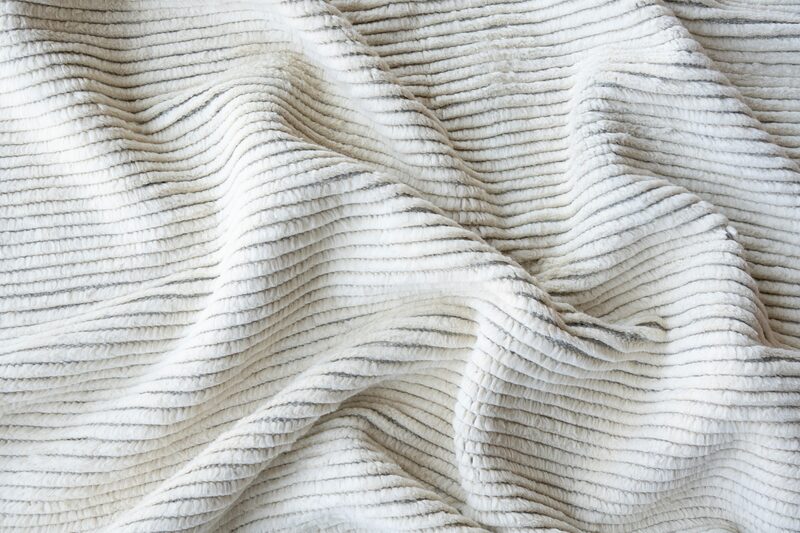
Wool's design range is unusually broad. WOVEN's Distressed Wool collection uses natural wool, low shearing, and tonal variation to create an earthen, lived-in surface. That example is useful because it shows that material character comes from the relationship among fiber, yarn, color, pile, and finish, not from the word wool alone.
Why designers choose silk rugs
Designers choose silk when light behavior, fineness, and surface movement are central to the room. A silk pile can shift markedly as the viewer moves around it because the filaments and pile direction reflect light differently. That movement can give a quiet field depth or make a drawn pattern feel unusually exact.
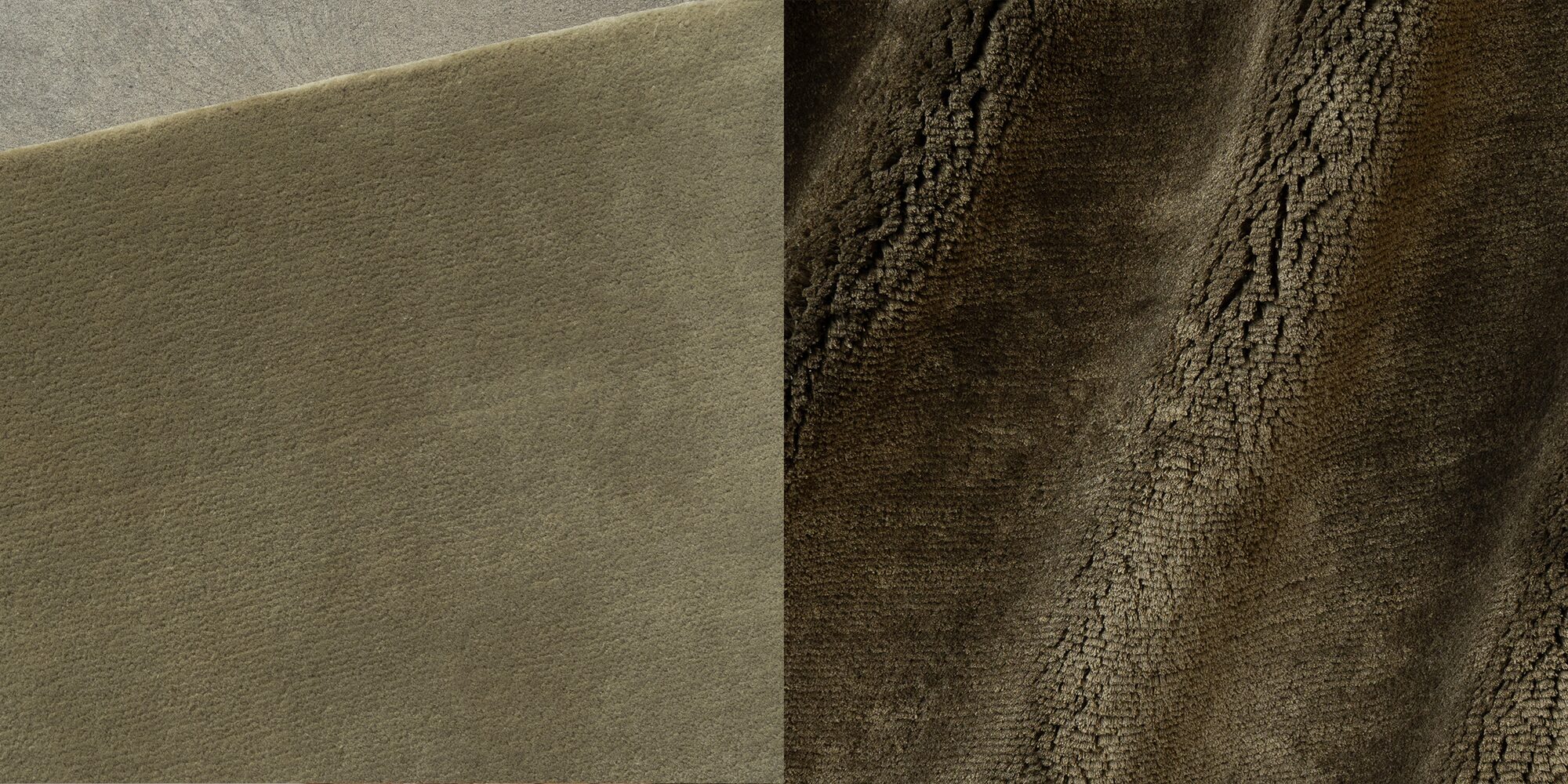
Silk should not be reduced to shine. WOVEN's Distressed Silk collection combines directional sheen with a low pile and distressed texture, while Sheared Silk uses dense pile and hand-cut surface variation. The two examples demonstrate that the same named fiber can produce different visual and tactile results.
The tradeoff is that silk asks for more deliberate placement and maintenance planning. Silk is less elastic than wool, becomes weaker when wet, and is particularly sensitive to prolonged light exposure. Its reflective surface can also make pile reversal, footprints, pressure, dust, abrasion, or a change in nap more visible. Some of that visual change is normal surface behavior rather than damage, but the distinction should be evaluated on the individual rug.
Read a silk rug from four viewpoints
A silk rug should be viewed from at least four positions before its color and contrast are approved. Directional reflection can make a single surface look markedly different from the entry, window, principal seating position, and opposite end of the room.
Use this four-view review:
- From the primary threshold: Does the rug read lighter or darker when the room is first entered?
- Facing the principal daylight source: Does reflected light flatten the pattern or clarify it?
- From the main seated position: Does the chosen orientation support the intended field, border, and furniture relationship?
- From the reverse direction: Does the color shift remain desirable, or does it change the room's balance?
The same review benefits wool rugs with a directional pile, but it is especially useful for silk. A sample should be rotated in the actual room light; a photograph or one fixed sample orientation cannot represent every view.
Wool-silk blends should be mapped, not reduced to a percentage
A wool-silk blend is not simply a midpoint between two materials. The design effect depends on where each fiber appears, how the yarns are constructed, whether they share a pile height, and how the surface is finished.
Silk used only in selected motifs can act like illumination, lifting outlines or changing the figure-ground relationship as the viewer moves. Silk distributed throughout the field creates a different maintenance and visual condition. Wool used as the primary pile with silk accents is not equivalent to silk pile on a wool foundation, nor does a percentage by weight explain which areas receive traffic or reflect light.
For a blend, request a material map that identifies:
- fiber content and percentages when available;
- the fiber used in the field, motifs, border, and ground;
- pile height or level changes between materials;
- foundation, backing, and secondary materials;
- finishing or washing applied to each surface; and
- the approved sample orientation under representative light.
STUDIO WOVEN uses material combinations as part of contemporary surface design. The relevant lesson is not that a blend is automatically more luxurious; it is that material placement can function like drawing, texture, and light within the composition.
Fiber content is evidence, not an impression
A rug that looks silky is not necessarily made from silk. Viscose, rayon, and other manufactured or plant-derived fibers can be marketed with suggestive terms, while finish and pile direction can make several fibers appear lustrous. Appearance, touch, price, or a burn test performed by an owner is not a responsible identification method.
Ask for clear fiber-content documentation and identify whether the stated material refers to pile, foundation, backing, highlights, or the entire textile. For a custom rug, include those distinctions in the specification and approval sample. For an antique, vintage, or high-value rug with uncertain material, seek qualified examination rather than testing the object at home.
This distinction also protects the later care plan. A cleaner cannot choose a responsible process from a vague description such as silk-like, and a designer cannot compare two proposals fairly when one lists pile content and the other lists total textile weight.
Silk is not automatically finer, better, or more valuable
Silk content does not prove quality, fineness, authenticity, age, rarity, or value. A rug's merit depends on the whole object: design, drawing, construction, materials, execution, color, condition, scale, provenance, documentation, and suitability for the intended use.
The same principle applies to wool. Wool is not a lower tier simply because silk is present in another option. A beautifully drawn and well-made wool rug may be the stronger artistic, tactile, practical, and long-term choice for a room. Material cost and reflective appeal should not replace object-level judgment.
In antique rugs, the presence of silk can occur in pile, highlights, foundation, or later repairs. No single visual clue establishes original material or market value. Condition and attribution should be assessed by a qualified rug specialist or textile conservator when the decision is consequential.
Plan maintenance before choosing the material
The right rug is one whose maintenance needs fit the room and the people responsible for it. Before selecting wool, silk, or a blend, define the likely soil, spill, moisture, sunlight, furniture, pet, child, footwear, housekeeping, and professional-cleaning conditions.
Both wool and silk can be damaged by unsuitable chemistry, uncontrolled wetting, friction, heat, poor drying, pests, and accumulated grit. Silk's lower elasticity, reduced strength when wet, and light sensitivity justify particular caution, but wool also requires fiber-, dye-, construction-, and condition-specific care. Do not infer a cleaning method from fiber name alone.
For routine stewardship, use only the rug maker's or qualified specialist's instructions for the specific object. Arrange professional assessment for stains, dye movement, odor, moisture, insect activity, brittle areas, open structure, prior repairs, valuable or antique rugs, and any uncertainty about material identity. Avoid owner-applied spot chemistry, wet testing, rubbing, brushing, or improvised fiber tests.
A seven-step wool-versus-silk selection framework
The most reliable choice begins with the room, then tests the finished rug against that reality. This order keeps material appeal connected to use rather than allowing a fiber label to decide the project.
- Define the room load. Record traffic paths, furniture, food, pets, children, footwear, moisture, daylight, and housekeeping.
- Name the desired surface effect. Decide whether the room needs diffuse warmth, directional movement, fine contrast, plushness, quiet texture, or a controlled combination.
- Verify the material. Request exact pile and foundation content, percentages where relevant, and clarification of any
silk-liketerminology. - Read the construction. Review yarn, knot or interlacing method, density, pile, backing, finish, edges, and individual condition.
- Map a blend. Identify where wool and silk occur instead of relying on one overall percentage.
- View the sample four ways. Rotate it under the room's daylight and artificial light, then review it from threshold, window, seating, and reverse directions.
- Confirm the care plan. Obtain object-specific maintenance guidance and decide who is responsible for routine care, incidents, and professional cleaning.
Which is better: a wool rug or a silk rug?
Wool is usually the better default when a room needs a grounded surface with broad practical range. Silk is the better choice when its fine, directional, light-responsive character is important enough to justify more controlled placement and maintenance. A wool-silk blend can be the most articulate option when each fiber has a deliberate role.
The final decision should never rest on prestige or fiber name. Compare the actual rug, the actual room, and the evidence that connects material, construction, light, use, and care. That is how wool, silk, or a blend becomes a design decision rather than a hierarchy.