knowledge library / A Guide to the Different Types of Persian Rugs
Persian rug types are most usefully understood as overlapping weaving traditions, not a single ranked list. Names such as Tabriz, Kashan, Heriz, Kerman, Sultanabad, and Qashqai may point to a city, region, workshop network, community, or trade convention. Each label becomes meaningful only when read with the rug's structure, materials, drawing, palette, age, and condition.
In this guide, Persian means made in Iran. A design woven elsewhere may be Persian-inspired or described by a Persian-style pattern, but design influence is not the same as origin. The distinctions below describe recurring tendencies rather than fixed recipes; an individual rug may cross categories, and a responsible attribution often remains qualified.
What does a Persian rug type actually describe?
A Persian rug type is a practical label for a related group of weavings. The label may refer to where a rug was made, the market through which it was sold, the community associated with its production, its construction, or a recognizable combination of design and structure. Because those categories overlap, the type name is a starting point for reading the object, not a complete identity.
Place names dominate the trade vocabulary because weaving developed across many Iranian cities, villages, districts, and mobile communities. Yet designs traveled with weavers, merchants, commissions, and changing markets. Spellings also vary in English: Kerman and Kirman, Isfahan and Esfahan, Qom and Ghom may refer to the same place or family of labels. The most useful question is therefore not simply, “What pattern does this resemble?” but “Which features support this attribution together?”
What are the three broad families of Persian rug types?
Persian rug traditions can be oriented through three broad families: city and workshop production; regional, village, and trade groups; and tribal or nomadic traditions. These families are not a hierarchy of quality, and their boundaries are permeable. They help explain how design was organized and transmitted, but the rug itself still has to support the name.
| Family | What the label usually points to | Recurring tendencies | Representative names | Important caution |
|---|---|---|---|---|
| City and workshop | An urban production center or workshop network | Planned compositions, curvilinear drawing, fine articulation, specialized production | Tabriz, Kashan, Isfahan, Kerman, Qom | Not every rug with fine floral drawing comes from a city workshop |
| Regional, village, and trade | A district, cluster of villages, or market category | Strong local structure and palette; geometric, floral, or hybrid drawing | Heriz, Serapi, Sultanabad, Mahal, Hamadan, Bijar | A trade name may cover several production places or periods |
| Tribal or nomadic | A weaving community, confederation, region, or mobile way of making | Portable looms, wool-rich structures, geometric or improvised drawing, multiple textile uses | Qashqai, Afshar, Luri, Bakhtiari | “Tribal” is not a synonym for crude, simple, or anonymous |
Which city and workshop Persian rug types should you know?
City and workshop Persian rugs are generally associated with organized production, planned designs, and the ability to render intricate curvilinear forms. That description covers a range of qualities and periods, not a uniform standard. Tabriz, Kashan, Isfahan, Kerman, and Qom are best understood as distinct design languages with internal variation.
Tabriz rugs: breadth of design rather than one fixed pattern
Tabriz rugs are notable for the breadth of their design vocabulary. Medallions, all-over repeats, garden plans, pictorial subjects, and highly articulated floral fields all appear within the tradition, with palettes ranging from quiet to emphatic. For an interior, the useful Tabriz question is not whether the rug looks “formal,” but how its drawing density, symmetry, and color intervals will relate to the room.
Kashan rugs: disciplined floral drawing and balanced fields
Kashan rugs are commonly associated with finely organized floral drawing, central medallions, and carefully balanced borders. Wool pile on a cotton foundation is common in many periods, while silk and mixed luxury materials belong to particular productions rather than to every Kashan. A floral medallion alone does not establish the label; the weave, materials, proportions, and drawing must agree.
Isfahan, Nain, and Qom rugs: refinement with different histories
Isfahan, Nain, and Qom rugs often enter the same design conversation because many examples favor precise curvilinear work, clear symmetry, and relatively controlled palettes. They should not be collapsed into one type. Their production histories, materials, structures, and characteristic color relationships differ, and later examples may reflect workshop or market decisions that complicate a purely visual identification.
Kerman and Ravar Kerman rugs: curvilinear range and trade terminology
Kerman weaving is known for a wide curvilinear vocabulary that can include medallions, all-over floral systems, vase compositions, pictorial subjects, and elaborate borders. Ravar or Lavar Kerman is often used for especially fine Kerman-group production, but the trade name has not always mapped neatly to a single place. This is a useful example of why rug terminology must be tested against structure and history rather than accepted literally.
Which regional, village, and trade Persian rug types should you know?
Regional, village, and trade labels often gather multiple local productions under a name that became legible to the market. These rugs can be finely or robustly woven, geometric or curvilinear, small or room-size. Their visual power often comes from the relationship between a strong organizing structure and the variation introduced by local materials and drawing.
Heriz and Serapi rugs: related northwest traditions, not interchangeable grades
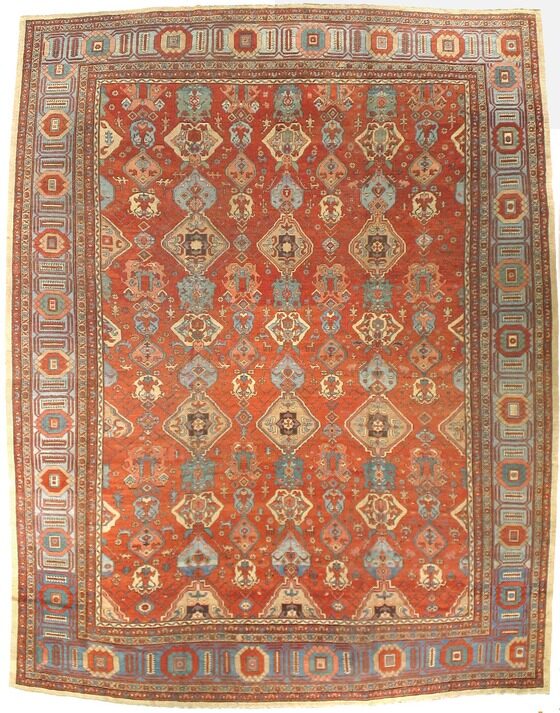
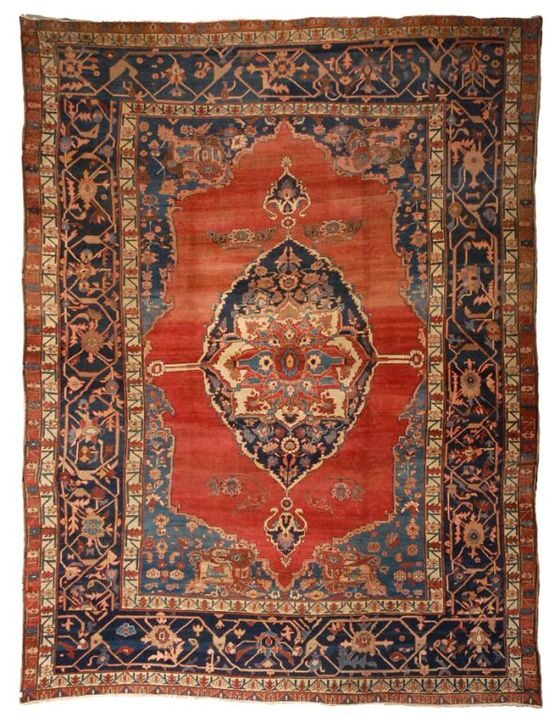
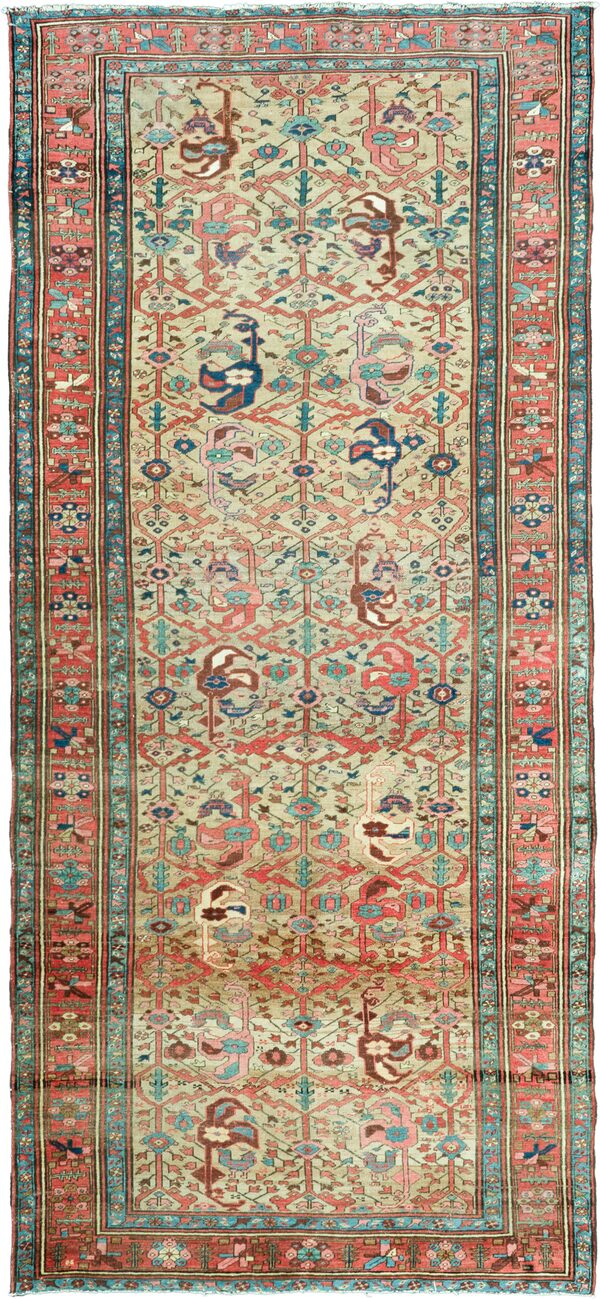
Heriz rugs are associated with northwest Iran and are often recognized by angular medallions, geometricized floral forms, strong outlines, and architectural scale. Serapi is a related market label, commonly applied to a narrower group of older, often more spaciously drawn carpets within the broader Heriz-area conversation. “Serapi” should not be used as a simple synonym for better Heriz; age, attribution, structure, condition, and artistic quality still need separate judgment.
Sultanabad, Mahal, Farahan, and Sarouk rugs: the Arak-region spectrum
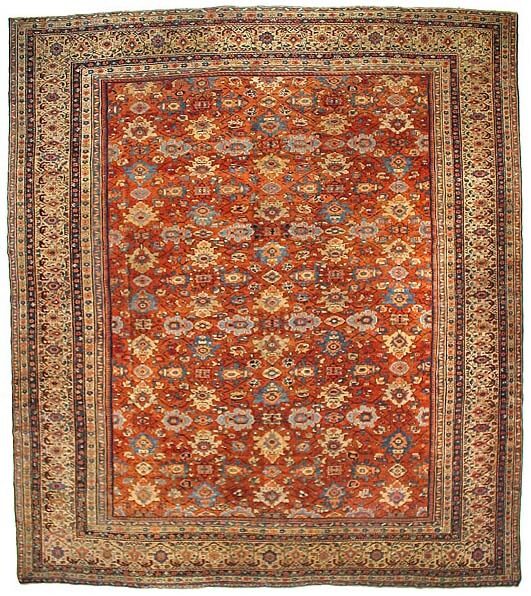
Sultanabad rugs, along with Mahal, Farahan, and Sarouk, belong to a broad west-central Iranian production story shaped by local weaving and export demand. Sultanabad and Mahal often appeal to designers for generous scale and open floral rhythms, while Farahan and Sarouk can present denser, more disciplined fields. These are tendencies across related market histories, not a ladder from casual to important.
Hamadan and Bijar rugs: regional variety and structural character
Hamadan functions as an umbrella label for rugs associated with a large area and many village traditions, so design, palette, and weave can vary considerably. Bijar is often recognized by a compact, heavily packed structure and a strong field organization, but density alone does not prove a Bijar attribution or predict the condition of an individual rug. In both groups, the reverse and handle of the rug are especially informative.
What distinguishes tribal and nomadic Persian rug traditions?
Tribal and nomadic Persian rug traditions are tied to specific communities and regional histories, not to a generic rustic look. Qashqai, Afshar, Luri, and Bakhtiari are among the names encountered in the field, but even these labels can describe a community, territory, confederation, or trade grouping differently. Precise cultural attribution should be made only when evidence supports it.
Many mobile and rural weaving traditions used horizontal looms and locally available wool, while designs could be developed from learned repertoires without the full-scale cartoons associated with some workshops. The results include knotted pile rugs, flatweaves, bags, bands, covers, and other textiles made for use as well as exchange. This breadth matters: a Persian tribal weaving should be read as an object with a function and structure, not reduced to its motifs.
Are pile rugs and flatweaves different Persian rug types?
Pile and flatwoven structures are different ways of making Persian rugs, and construction may cut across geographic labels. In a knotted pile rug, yarn knots form a raised surface around the warps and are secured by wefts. In a flatweave, the visible surface is created without a cut pile; gelim or kilim is one important family within Iran's much wider flatweaving practice.
Both asymmetric and symmetric knots appear in Iranian rugs. The asymmetric structure is often called the Persian knot, but its presence cannot prove that a rug was made in Iran; nor does a symmetric knot exclude Iranian origin. Knot count is equally limited as a stand-alone measure. It can help describe how finely a design is articulated, but wool quality, drawing, color, structure, condition, and execution remain independent questions.
How does WOVEN evaluate a Persian rug type label?
At WOVEN, we treat a Persian rug type as a working attribution and test it across the whole object. WOVEN's founder, Abraham Moradzadeh, entered the rug trade in Isfahan and later opened a store in Tehran; that history informs a method based on comparison and close looking rather than a single visual shortcut.
- Start with the label family. Ask whether the name refers to a city, district, village network, community, structure, period, or trade convention.
- Read the composition. Note the field, borders, medallion or all-over plan, drawing scale, symmetry, spacing, and how motifs are resolved.
- Turn the rug over. Examine knot structure, warp depression, wefting, foundation, edge and end finishes, and the clarity of the drawing from the reverse.
- Assess material and color together. Consider pile fiber, foundation, spin, sheen, palette, abrash, and whether color change comes from weaving, wear, fading, or later work.
- Separate attribution from condition. Wear, corrosion, repair, reweaving, reduced ends, and altered sides may affect what can be seen and how confidently the rug can be classified.
- State the confidence level. Use “attributed to,” “Heriz-area,” “Kerman group,” or “in the style of” when the evidence does not justify a more exact claim.
This method protects two different kinds of value. It respects the specificity of Iranian weaving traditions, and it gives buyers and designers a more accurate basis for comparing rugs. When age, origin, authenticity, restoration, rarity, provenance, or value matters to a decision, photographs and labels are not enough; the individual rug should be examined by a qualified specialist.
How should Persian rug types influence an interior decision?
Persian rug types are most useful in design when they help predict visual rhythm, not status. Broad geometric drawing can hold its own in an architecturally spare room; an all-over repeat can remain coherent beneath a dining table; a central medallion benefits from enough visible floor area to read; and finely articulated floral work rewards closer viewing and considered light.
We begin with the room's scale, furniture plan, circulation, and desired contrast, then use type language to narrow the field. A softly colored antique Persian rug may quiet a room even when its pattern is complex, while a boldly drawn village rug may create order through a few large forms. Pattern density and color contrast often matter more to the interior than whether a label is conventionally described as formal or tribal.
What are the most common misconceptions about Persian rug types?
The most common misconceptions turn useful tendencies into absolute rules. Persian rug labels are interpretive tools, and none of the following shortcuts can carry an attribution or quality judgment on its own.
- A city name does not guarantee city manufacture. Some names became regional or commercial categories.
- A familiar motif does not prove origin. Designs circulated and were reinterpreted across regions and countries.
- The Persian knot does not prove Persian origin. Knot structures cross borders, and Iranian rugs use more than one knot type.
- More knots do not automatically mean a better rug. Fineness matters only in relation to materials, drawing, execution, condition, and purpose.
- “Tribal” does not mean primitive or roughly made. It should refer to a supportable weaving context or community, not an aesthetic stereotype.
- Type does not determine value. Age, artistic quality, condition, rarity, provenance, restoration, size, and market context must be evaluated separately.
How should you choose among the different types of Persian rugs?
Choose a Persian rug by using the type name to begin a closer reading, then judge the particular piece in front of you. The strongest selection aligns the rug's scale, drawing, color, structure, condition, and attribution confidence with the room and the buyer's priorities. A well-known label can be helpful, but a coherent, beautiful, properly understood rug is the better guide.