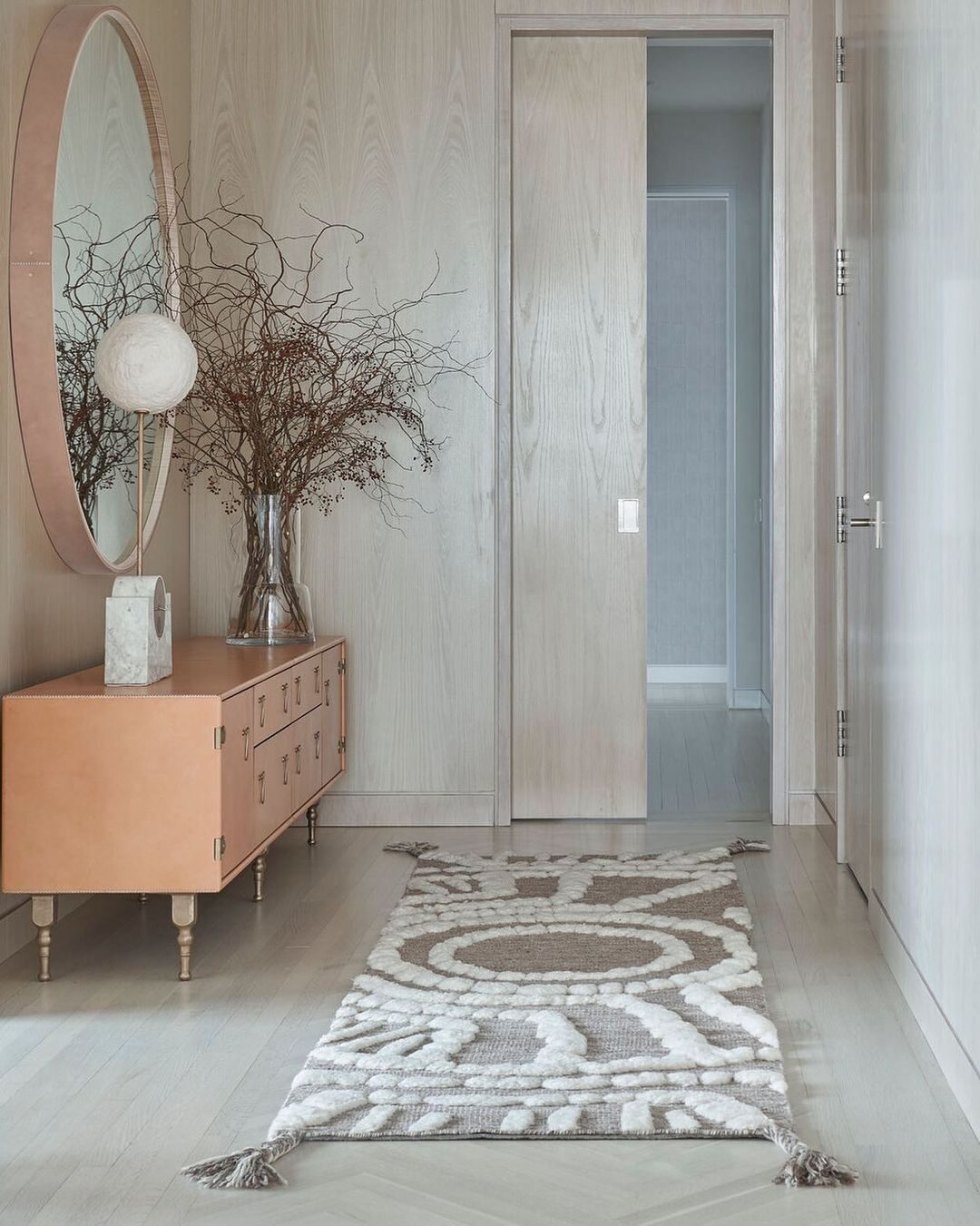
knowledge library / Runner Proportions: Hallways, Galleries and Long Architectural Spaces
A runner should be proportioned to the clear walking path and architectural sequence, not selected by a generic size rule. Its width establishes the side bands of visible floor; its length should begin and end at intentional architectural events; its pattern should support the direction and cadence of movement; and its surface, pad, edges, doors, and thresholds must function as one coordinated floor interface.
The strongest runner feels related to the hall without looking installed wall to wall or stranded in the middle. That balance comes from four alignments: width, endpoints, rhythm, and interface.
What is a runner rug?
A runner rug is an elongated floor covering designed for a narrow or directional space. Hallways are the familiar setting, but runners also belong in galleries, connecting passages, dressing corridors, library aisles, and open-plan routes where a long axis needs definition.
Runner is a format, not a single construction or fixed ratio. Hand-knotted pile rugs, flatweaves, and other structures may all use runner proportions. Material, thickness, edges, condition, and pad determine behavior underfoot. WOVEN's Lania Runners collection provides one contemporary starting point, subject to project-specific confirmation.
This guide addresses horizontal spaces. Stair runners require a different measurement and installation process because tread, riser, nosing, turns, landings, and attachment govern the specification.
How wide should a hallway runner be?
A hallway runner should be wide enough to read as the principal walking field while leaving deliberate bands of floor on both sides. The governing measurement is the clear architectural width, taken between the actual obstructions and finishes that shape the passage, not merely the dimension between nominal walls.
Record baseboards, casings, radiators, built-ins, registers, projecting millwork, and every change in corridor width. Then draw options at approximately 60, 70, and 80 percent of the narrowest relevant clear width. These are comparison studies, not rules:
- A narrower runner exposes more floor and reads as an independent object.
- A middle option usually balances rug and architecture without approaching wall-to-wall coverage.
- A wider runner creates a more continuous carpeted field but makes edge alignment, door clearance, and pad control more prominent.
Judge the exposed floor as a designed edge band. Equal side bands usually create calm in a symmetrical corridor, but equal measurement is not always the right visual answer. An off-center door sequence, built-in, or architectural reveal may justify aligning the runner with the true walking axis rather than the wall centerline.
Where should a runner begin and end?
A runner should begin and end in relation to recognizable architectural events. Centering a standard length within the overall hall can leave both ends looking accidental, especially when one end approaches a threshold and the other stops beside a partial doorway.
Use three endpoint types:
- Threshold endpoints align the runner with a doorway, material transition, or clear change between spaces.
- Bay endpoints place the rug within a repeated architectural interval, such as the first and last full door, window, or wall bay.
- Anchor endpoints relate the runner to a console, bench, artwork axis, opening, or terminal view.
The start and finish need not mirror each other, but each needs a reason. Check both directions and the adjoining rooms. A runner may look resolved from one end but clipped or intrusive from the other.
Doors add another layer. Confirm swings, undercuts, pivots, closers, and the rug's complete finished profile with its pad. A floor-plan line does not show whether a door will brush the pile, catch an edge, or compress the surface over time.
How do proportions change across different long spaces?
Runner proportion changes with the spatial sequence, even when two passages have similar dimensions. The runner should reinforce the way the space is entered, crossed, paused within, and left.
| Space condition | Width emphasis | Length and endpoint emphasis | Design risk to test |
|---|---|---|---|
| Compact residential hall | Preserve a clear walking field without crowding the walls | Relate both ends to complete door or threshold conditions | A standard length that floats between unrelated openings |
| Long gallery | Balance the runner with wall bays, artwork, lighting, and long sightlines | Use a continuous endpoint logic across the full sequence | Repetition that becomes monotonous or a runner that feels visually endless |
| Connecting corridor | Keep the path legible through several doorways | Decide whether the rug belongs to one room, the connector, or the whole axis | Ends that intrude into adjoining rooms or stop in door swings |
| Open-plan walkway | Define movement without pretending the route is an enclosed hall | Align to circulation, furniture edges, and floor transitions | Exposed edges entering cross-traffic or furniture zones |
| Hall with a turn or offset | Maintain a coherent width through changing geometry | Decide whether to stop, turn with a custom solution, or use separate pieces | Forced bends, unresolved corners, or mismatched endpoint logic |
The table is diagnostic; a runner does not belong in every passage. Uninterrupted flooring may be stronger where doors, cross-traffic, wheels, carts, moisture, or regulated circulation make a loose textile difficult to integrate.
How should pattern work in a long hallway or gallery?
Runner pattern should create direction without reducing the space to a visual tunnel. Repeating medallions, stripes, borders, allover fields, and directional motifs establish different cadences, and the correct choice depends on the hall's length, viewing distance, door sequence, and terminal view.
At WOVEN, we review runner pattern in three ways. Progression asks what the eye encounters while moving along the rug. Intervals compare motif repeats with doors, wall bays, lights, and artwork. Termination examines what happens at each end: a complete medallion, a deliberate crop, a border, or a field that appears to continue.
Long galleries often benefit from variation within repetition. A small repeat can create vibration, while one oversized motif may disappear beneath furniture or openings. Borders emphasize long edges and uneven margins. Borderless fields feel more continuous but still need deliberate endpoints.
Color changes with distance as well. A complex runner may blend into a dominant field color from the far end, then reveal secondary hues and linework at close range. Review the full piece or full-length artwork from the threshold, midpoint, and terminal view rather than approving only a small sample.
When should a designer use one runner or several?
One continuous runner is strongest when the architecture reads as one passage and the floor, width, pattern, and circulation remain coherent from end to end. Several runners are more convincing when thresholds, turns, level changes, cross halls, or distinct architectural bays create real breaks.
Do not divide a long hall only because standard lengths fall short. A sequence of runners creates additional endpoints and exposed edges, so each interval needs enough architectural support to look intentional. Conversely, do not force one continuous runner through a turn, doorway, or material transition merely to avoid a gap.
For multiple pieces, draw the negative space between them. Align gaps with doorways, intersections, ceiling breaks, or lighting bays. Compare width, border language, pattern density, color, and condition without requiring a match. The aim is a readable sequence.
What surface and edge conditions matter most?
Surface and edge conditions matter because a runner places long, exposed edges directly beside a walking path. Construction, pile, backing, fringe, side finish, pad, floor material, transitions, cleaning, and use must be reviewed together rather than selected independently.
A lower profile may simplify some door and transition conditions, which makes modern flatweaves and vintage Kilim rugs useful construction families to compare. Flatwoven does not automatically mean stable, durable, easy to clean, or suitable for a particular hall. The complete object and floor interface still govern.
The pad should fit the actual runner and floor, remain concealed, and provide the required grip and cushioning without an unsuitable edge. Confirm compatibility with the floor, coatings, radiant system, and maintenance products. Recheck after doors and transitions are complete.
In public, hospitality, workplace, or other regulated settings, do not assume a loose runner meets requirements written for installed carpet. Stable and firm surfaces, exposed edges, rolling movement, clear routes, fire performance, and local code interpretation require project-specific review by the responsible professionals.
How should an antique or vintage runner be specified?
An antique or vintage runner should be fitted as an individual object, not ordered from a nominal dimension. Measure width and length at several points, record orientation and irregularity, and review the full front and reverse along with ends, sides, fringe, pile, foundation, repairs, stains, distortion, and prior alterations.
WOVEN's Sarab rugs are a relevant antique runner tradition, and the broader antique Persian rug collection provides additional sourcing context. A regional or market label does not prove that an individual rug will fit, lie flat, tolerate the intended use, or meet a project's condition standard.
Use the rug's actual outline, not an ideal rectangle. A width change, bowed side, angled end, or fringe may suit one interior and distract at a sharply aligned threshold. Avoid concealing weak areas or concentrating furniture loads without specialist review.
When condition, cleaning, repair, value, or installation is uncertain, obtain a qualified rug or textile assessment before approval. Do not trim, fold, stretch, resize, attach, or treat an antique runner simply to force it into a plan.
When is a custom-length runner justified?
A custom-length runner is justified when the correct architectural endpoints cannot be achieved with an existing piece and the runner's width, pattern, construction, and edge treatment can be developed coherently at the required length. Custom should solve the sequence, not merely fill every available inch.
Confirm how the design adapts: whether motifs repeat, elongate, crop, or are redrawn; how borders meet the ends; which dimensions govern; what tolerance applies; and whether the rug will be made as one piece. Approve full-length artwork in addition to material and color samples. A small sample cannot show the cadence of a long repeat or the final relationship between the first and last motif.
Confirm WOVEN capability, maker constraints, sampling, timing, packing, access, installation, pad, and commercial terms for the project. A custom-length request does not make every design or construction adaptable.
A seven-step WOVEN runner specification framework
A runner is ready to specify when width, endpoints, rhythm, and interface agree. Use the following sequence before release:
- Measure the clear path. Record changing widths, projections, doors, transitions, and the actual walking axis.
- Study the edge bands. Compare several runner widths and evaluate the visible floor on both sides from each direction.
- Choose architectural endpoints. Tie the start and finish to thresholds, bays, or anchors rather than leftover space.
- Test the pattern sequence. Review progression, intervals, and termination in a full-length drawing or the actual rug.
- Resolve every interface. Confirm pile, edges, fringe, pad, floor compatibility, doors, thresholds, cross-traffic, and cleaning access.
- Verify the object or production route. For an existing runner, document dimensions and condition; for custom work, approve adaptation, construction, tolerance, sampling, and finished dimensions.
- Mock up and sign off. Mark the complete outline on the finished floor, walk both directions, operate every door, review regulated requirements where applicable, and retain the approved plan and product record.
The right runner does not simply occupy a narrow strip of floor. It edits the experience of moving through architecture. When its width establishes calm side bands, its ends recognize real spatial events, its pattern carries an intentional rhythm, and its edges work with the floor, the runner feels integral without pretending to be permanent.