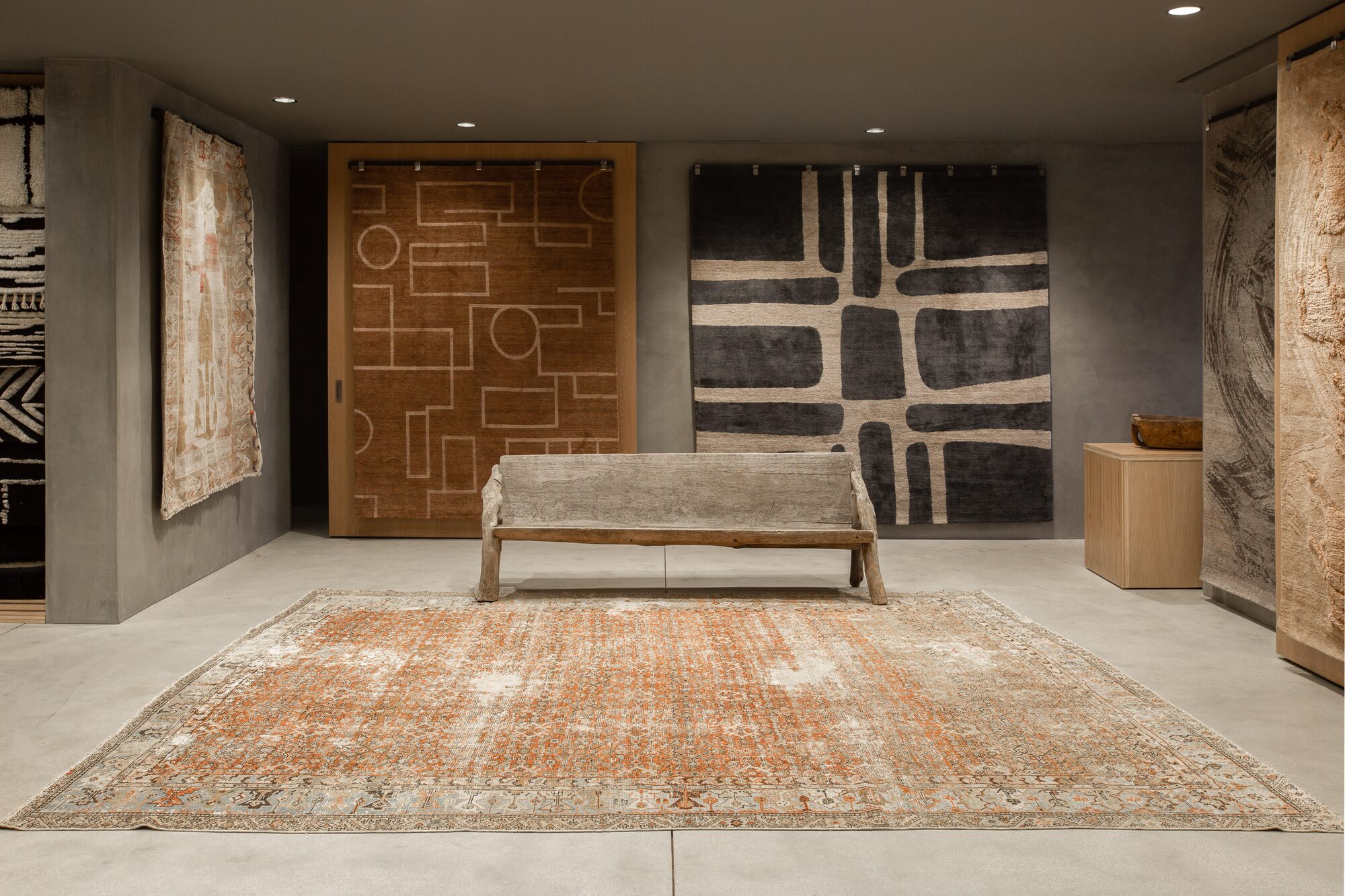
knowledge library / What Interior Designers Should Expect From a Rug Trade Partner
A strong rug trade partner should reduce uncertainty from the first brief through final handoff. Designers should expect informed curation, clear product evidence, material and construction guidance, disciplined samples and approvals, current pricing and availability, early risk communication, and explicit responsibility for freight, delivery, and installation. The value lies not only in finding rugs, but in making each decision legible.
A rug trade partner is more than a product source
A rug trade partner connects design intent to a rug that can be evaluated, approved, ordered, delivered, and used as planned. A seller can provide inventory and a price. A partner should also understand the room, explain relevant tradeoffs, identify what is known and unknown, coordinate evidence, and define where its responsibility begins and ends.
That distinction matters because rugs combine several kinds of decisions at once: scale, furniture planning, color, material, construction, condition, production, care, access, and installation. A recommendation that looks right in isolation may fail when it meets a door clearance, dining-chair movement, a tight delivery route, an unresolved repair, or an approval deadline.
WOVEN's perspective is shaped by decades in the rug trade, daily work with interior designers, the curation of antique and vintage pieces, and the development of contemporary rugs. From that perspective, the best partner is not the one that produces the longest list of options. It is the one that helps the design team make a smaller number of better-supported decisions.
Use the room-object-handoff test
The room-object-handoff test gives designers a practical way to evaluate both a rug and the partner recommending it. Every serious proposal should answer three groups of questions.
| Test | What the partner should understand | Evidence the designer should receive |
|---|---|---|
| Room | Furniture plan, finished rug dimensions, circulation, doors and thresholds, floor, light, traffic, visual role, schedule, and budget boundary | Scaled placement or dimensions, fit rationale, room-specific cautions, and unresolved site questions |
| Object | Identity, construction, material, color, pile or profile, condition, size, variation, care implications, and availability | Current images or sample, product details, condition information where applicable, dimensions, and qualified claims |
| Handoff | Price scope, approvals, lead-time status, payment, packing, freight, receiving, delivery, installation, inspection, and care | Written inclusions, exclusions, responsible parties, decision dates, order status, and change record |
A partner does not need to perform every task. The requirement is clarity. When a receiving warehouse, installer, workroom, conservator, or other specialist owns part of the process, the partner should identify that boundary early enough for the designer to coordinate it.
What should a trade partner learn before presenting rugs?
A trade partner should understand the project before sending options. A few photographs and a color request rarely provide enough context for a responsible recommendation.
A useful intake should establish:
- the room and project type;
- the furniture plan and intended finished rug dimensions;
- whether the rug should anchor, connect, quiet, contrast, or lead the composition;
- relevant colors, materials, architecture, light, and adjacent rugs;
- traffic, furniture movement, household or operational conditions, and care expectations;
- floor type, thresholds, doors, stairs, transitions, and known access constraints;
- preference for an existing, antique or vintage, adapted, or fully custom path;
- budget boundary, decision date, installation target, and the confidence of each date;
- stakeholders, approval authority, purchasing entity, and required documentation.
The partner should also ask what is flexible. Size may be fixed while palette can move. The design may need one old rug but tolerate several origins. A custom surface may be essential while exact artwork remains open. Knowing where the brief can bend allows curation to be intelligent instead of broad.
A good partner explains the sourcing paths before narrowing them
A good rug trade partner should explain the consequences of each sourcing path rather than steering every brief toward the same inventory or service. Existing, antique or vintage, and custom rugs involve different kinds of certainty.
| Sourcing path | What it offers | What the partner should clarify |
|---|---|---|
| Existing new-production rug | A finished object that can often be reviewed at full scale | Current availability, exact dimensions, materials, construction, color variation, condition, delivery scope, and return terms |
| Antique or vintage rug | A one-of-one object with age, wear, repair, and individual character | Attribution confidence, actual dimensions, condition, restoration, color behavior, provenance limits, care, hold status, and project fit |
| Adapted design | An existing design modified in size, color, shape, or material where feasible | What may change, what remains fixed, sample and artwork requirements, price and schedule effects, and final approval scope |
| Fully custom rug | A project-specific composition, material plan, construction, and geometry | Design ownership, technical feasibility, development stages, samples, tolerances, revisions, production release, and logistics |
WOVEN's antique rug collection and vintage rug collection illustrate why one-of-one sourcing differs from specifying a repeatable product. A trade partner should present those differences as project consequences, not as a hierarchy in which one path is automatically better.
Rug expertise should translate terms into decisions
Rug expertise is useful when it changes a project decision. A partner should be able to explain how material, construction, pile, density, scale, condition, and finish affect the rug's appearance and use without relying on prestige labels or simplistic rankings.
For example, "wool and silk" is not a complete material recommendation. The designer needs to know where each material appears, how it changes light and hand, what construction carries it, and whether that surface suits the room. "Hand-knotted" identifies a broad making method, not an automatic guarantee of quality, durability, ethics, care ease, or project fit. A knot count may help describe resolution within a particular construction, but it does not replace judgment about drawing, yarn, structure, finish, and intended use.
For antique and vintage rugs, the partner should separate observable facts from attribution. Wear does not prove age. A trade label does not independently prove origin. Repairs may be acceptable, important, or disqualifying depending on their location, quality, stability, visibility, price context, and the project's intended use. High-stakes questions about condition, restoration, value, or authenticity may require appropriate specialist review.
Curation should make the decision smaller and clearer
Useful curation reduces a broad market to a legible set of choices. Sending many loosely related rugs transfers the editing burden back to the designer and can make client approval harder.
Each option should have a stated reason for inclusion. One may best resolve the furniture plan. Another may carry the room's color relationship. A third may offer the strongest condition or schedule confidence. The differences should be intentional enough that the designer can explain them to the client.
We recommend evaluating a presentation through three questions:
- Why this rug? State its role in the room and the part of the brief it answers best.
- Why this group? Explain the meaningful comparison among options: age, composition, texture, palette, construction, price scope, or timing.
- What decision comes next? Identify whether the team is choosing a direction, requesting a memo or sample, approving a custom study, confirming a hold, or releasing an order.
A trade partner should be comfortable removing an attractive rug when it no longer serves the plan. Editing is part of the expertise.
What evidence should accompany a rug recommendation?
A rug recommendation should arrive with enough evidence to evaluate fit, risk, and next steps. The exact record differs for a finished rug and a custom commission, but the partner should distinguish confirmed information from estimates and assumptions.
A useful seven-part evidence packet includes:
- Identity: Product, collection, inventory, or project identifier; category; maker or origin language only at the confidence supported.
- Geometry: Actual or proposed finished dimensions, shape, orientation, fringe or edge basis, and known tolerances where applicable.
- Surface: Material, construction, pile or profile, color, texture, sheen, relief, and relevant variation.
- Condition or sample status: Condition and restoration information for existing objects, or sample revision and approval scope for custom work.
- Commercial status: Current availability or hold, quantity, quoted price scope, quote date and validity, taxes or fees where applicable, and payment terms.
- Schedule and logistics: Status of production or inventory, stated dependencies, packing, freight, receiving, delivery, access, and installation boundary.
- Open questions: Claims, site conditions, approvals, tests, or responsibilities that remain unresolved.
The packet need not be elaborate. It needs to be current, attributable to the correct rug, and consistent across the proposal, sample, quote, invoice, and order record.
Availability, suitability, and readiness are different
Availability, suitability, and readiness should be tracked separately. An available rug exists for sale or allocation. A suitable rug fits the design and use based on the evidence reviewed. A ready rug has the approvals, commercial terms, site conditions, and logistical plan required for the next commitment.
Confusing those states creates preventable pressure. A one-of-one rug can be available but not yet suitable because condition or scale has not been reviewed. A custom design can be suitable but not ready because the sample, drawing, or price is not approved. A rug can be ordered but the site may not be ready to receive or install it.
A strong partner states the current status plainly:
- Available: current inventory or production capacity has been checked.
- Under review: fit, condition, sample, technical information, or terms remain open.
- Approved: the named stakeholder has approved a defined object or document.
- Released: the commercial and technical conditions for the next stage have been met.
- In transit or ready for delivery: movement is confirmed, with receiving and site responsibility assigned.
These terms should be adapted to the partner's actual system. What matters is that status language has a shared meaning.
Samples and approvals need a defined purpose
Samples and approvals should answer named questions. A loaned rug, yarn pom, material sample, strike-off, rendering, and production sample do not provide the same evidence.
The partner should explain what the designer is reviewing, what remains provisional, how the item should be handled, when it must be returned, and what decision follows. For a finished rug, an in-room review may test scale, palette, pile direction, and furniture relationships while leaving condition or floor-interface questions for separate review. For custom work, a sample may approve local color, material, pile, carving, or line resolution without proving the complete full-scale composition.
Every approval should name the rug or sample, revision, date, approving party, and scope. "Approved" is weak documentation when nobody can tell whether it refers to color, artwork, size, price, construction, or the final order.
Communication should surface risk before it becomes urgency
Trade communication should make status, decisions, and risk visible. Speed matters, but an immediate answer that hides uncertainty is less useful than a qualified answer with a clear verification step.
Designers should expect:
- one identifiable point of coordination, even when several specialists contribute;
- acknowledgment of the request and a realistic time for the substantive response;
- written confirmation of decisions, approvals, and changes;
- clear labels for confirmed, estimated, pending, and client-supplied information;
- early notice when availability, price, sample, production, freight, or site assumptions change;
- a current action list showing owner and due date;
- escalation to the right technical, condition, logistics, or installation specialist when needed.
The partner should not wait for perfect information before naming a risk. "This date depends on sample approval by Friday" is more useful than a confident delivery promise with an invisible condition.
Logistics and installation responsibilities must be explicit
Logistics and installation are part of the rug decision even when the trade partner does not perform them. The project needs an agreed chain from packing through final inspection.
Before ordering or shipping, clarify:
- who confirms final dimensions and site conditions;
- who packs, insures, and arranges freight;
- where risk and responsibility transfer;
- who receives, inspects, reports damage, and stores the rug;
- whether local delivery includes room placement or only threshold delivery;
- who specifies and supplies underlay;
- who confirms floor readiness, access, elevator or stair conditions, and furniture movement;
- who installs, seams, attaches, trims, or otherwise completes the work where applicable;
- who documents final condition and provides care information.
The relevant scope depends on the rug and project. A loose residential area rug, an oversized piece, a stair runner, and a hospitality installation should not inherit the same assumptions.
A partner's response to change reveals the relationship
Problem-solving should begin with a factual account of what changed, what it affects, and which decisions are available. Custom development, one-of-one sourcing, freight, site conditions, and client approvals can all introduce change; the standard is not a project with no problems, but a project in which problems are made legible early.
A useful change notice should state:
- the original approved condition;
- the new information or event;
- the effect on design, rug, price, schedule, or logistics;
- immediate containment or verification steps;
- viable options and their tradeoffs;
- the person authorized to decide;
- the revised record after the decision.
Accountability also means distinguishing a mistake from a normal handmade variation, a newly discovered condition issue, a client change, a carrier event, or an unresolved site dependency. Those categories may lead to different remedies and responsibilities. They should not be blurred to move the project forward quickly.
Ten questions to ask a potential rug trade partner
A first conversation should reveal how the partner thinks, documents, and responds when information is incomplete. Ask:
- What do you need from us before you begin sourcing or developing options?
- How do you distinguish existing, antique or vintage, adapted, and fully custom paths?
- What product, condition, material, construction, and origin information accompanies a proposal?
- How do you confirm current availability, holds, prices, and quote validity?
- What samples or in-room reviews are available, and what does each one approve?
- How are drawings, revisions, decisions, and production release controlled for custom work?
- Which parts of freight, receiving, delivery, underlay, and installation do you perform, coordinate, or exclude?
- How do you communicate a changed date, damaged shipment, unavailable rug, failed sample, or site conflict?
- Who remains accountable from first brief through final handoff?
- Which current terms, services, and project examples can you document rather than describe generally?
The quality of the answers matters more than the breadth of promised services. A focused partner with clear boundaries can be more useful than a full-service claim with vague ownership.
Common misconceptions about rug trade partnerships
Several assumptions can obscure what a project actually needs.
- "The largest inventory creates the best options." Inventory matters, but project understanding and disciplined editing determine whether the options are useful.
- "A fast response means the partner is reliable." Reliability also requires accurate evidence, qualified claims, visible dependencies, and follow-through.
- "Trade pricing is the main value." Commercial terms matter, but design judgment, samples, documentation, logistics, and risk control can change the total project outcome.
- "A sample guarantees the finished rug." A sample supports defined approvals; it does not prove every full-scale relationship or handmade variation.
- "Full service means the partner owns every task." Service language should be translated into named responsibilities, exclusions, and handoffs.
- "A longstanding relationship removes the need for documentation." Trust improves collaboration, but current records protect both the relationship and the project.
The right rug partner makes decisions more dependable
Interior designers should expect a rug trade partner to bring together design judgment, object knowledge, material and construction literacy, evidence, communication, and project control. The relationship succeeds when the team knows why a rug is being considered, what has been verified, what remains open, and who owns the next step.
WOVEN's STUDIO WOVEN and broader contemporary rug collection offer new-production reference points alongside the brand's antique and vintage holdings. Product availability, trade terms, samples, custom capabilities, and project services should always be confirmed for the current brief rather than inferred from a collection page.