knowledge library / Patina vs. Damage: How to Read Wear in an Antique Rug
Patina describes the visual character that age and use can give an antique rug; damage describes a material change that weakens, disfigures, or threatens it. The two can overlap. Evenly lowered pile or softened color may be beautiful, yet exposed foundation, splitting edges, unstable dyes, active pests, or distorted repairs require condition-based judgment. Read appearance, structure, and risk separately.
An old rug does not need to look new to be worth living with. A surface shaped by time can quiet a formal pattern, soften contrast, and make color sit more naturally beside wood, stone, plaster, and contemporary furniture. But age is not a protective category. A rug can look mellow from across the room while its foundation is breaking at the edges or a past repair is pulling the weave out of alignment.
At WOVEN, we find it more useful to ask three questions than to make a quick patina-or-damage judgment: What has changed visually? What has changed structurally? Is the change stable, or is it likely to continue? That separation preserves the character people respond to without romanticizing deterioration.
What does patina mean on an antique rug?
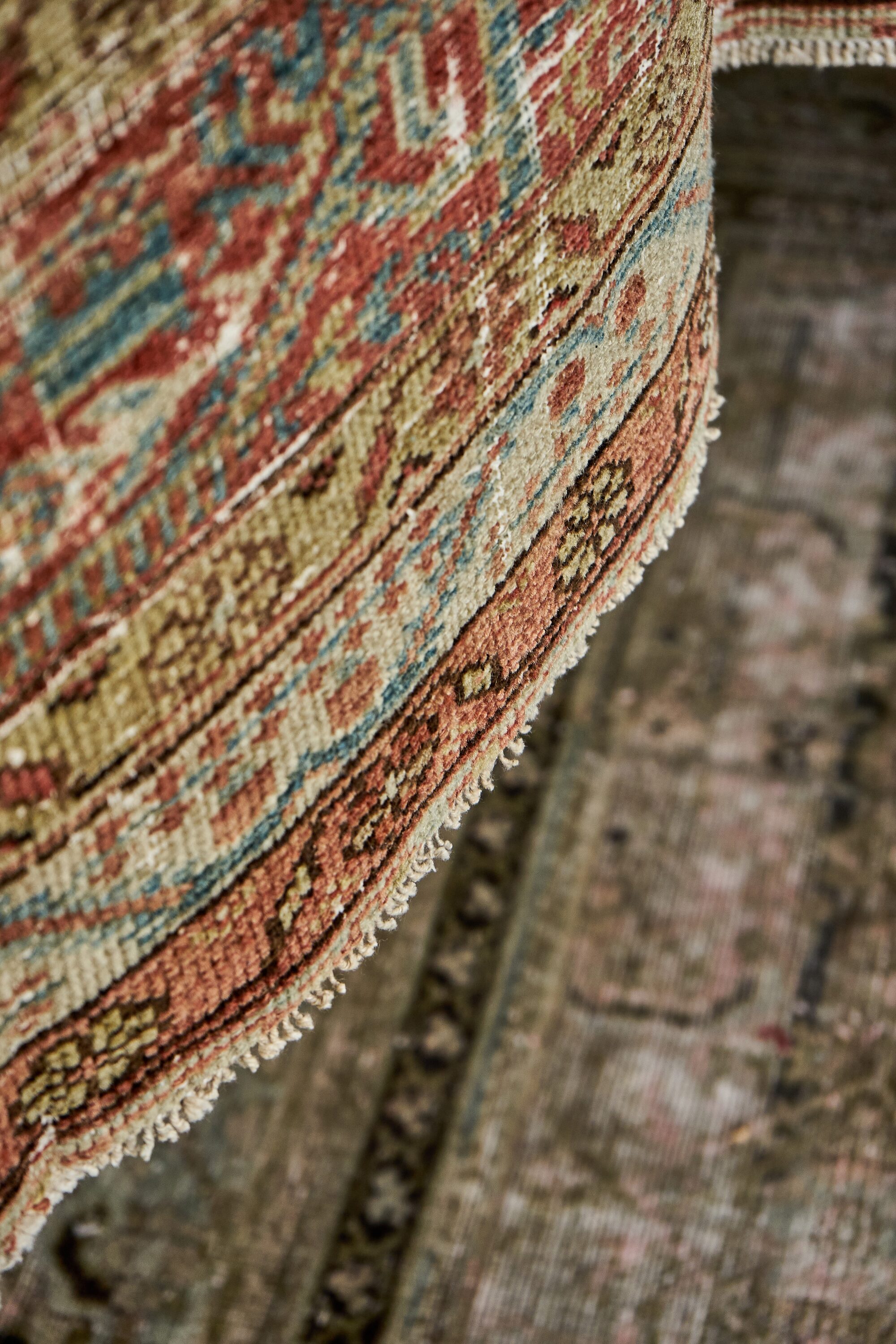
Patina on an antique rug is the cumulative surface character associated with age, use, light, handling, and earlier care. It may include a softened palette, compressed or lower pile, gentle variation in surface sheen, and evidence of long use. Patina is an interpretive term, not a technical condition grade, proof of age, or guarantee of quality.
The important word is character. Patina describes how change is perceived within the whole rug. A low, even surface may allow the drawing to remain legible while giving it a quieter presence. Small irregularities may reinforce the rhythm of a handmade object. Those effects can be aesthetically desirable even though they arose through physical wear or light exposure.
That is why “patina” should never replace a condition report. The term tells us that someone values the appearance of age; it does not tell us whether the pile is secure, the foundation is intact, the colors are stable, or the rug is suitable for a particular room.
When does wear become damage?
Wear becomes damage when material loss, weakness, distortion, contamination, or instability compromises the rug or makes further loss more likely. Exposed warps or wefts, open tears, separating ends, broken side finishes, brittle fibers, active insect evidence, dye movement, mold, and tension from poor repairs are more consequential than an even change in pile height alone.
Location and pattern matter. Broad, gradual wear across a field suggests something different from a sharp bald patch beside a tear. Loss at an end or edge can threaten the structure because those finishes help contain the woven body. A darkened area may be ordinary soiling, an old stain, adhesive residue, or moisture-related change; appearance alone cannot establish which. A photograph can help map a concern, but touch, flexibility, the reverse, and specialist examination may change the conclusion.
| What you see | What it may mean | What to check next |
|---|---|---|
| Evenly lowered or compressed pile | Long use may have softened the surface without interrupting the design. | Look for sound yarn, continuous structure, and whether the wear accelerates in traffic paths. |
| Foundation visible in isolated areas | Pile loss has progressed beyond surface mellowing and may leave the structure more exposed. | Examine the reverse, boundaries of the loss, broken yarns, and proposed room use. |
| Faded color | Light exposure can soften contrast, but fading is cumulative and irreversible material change. | Compare protected and exposed areas and check whether the change is directional or uneven. |
| Missing or separating fringe and side finish | Decorative irregularity may actually be loss at a structurally important end or edge. | Look for unraveling, broken foundation yarns, and earlier binding or overcasting. |
| Patch, reweaving, or backing | Earlier work may be stable and skillful, merely cosmetic, visually distracting, or actively distorting. | Ask what was added, how it is attached, whether it is documented, and whether tension is changing the shape. |
| Holes, grazing, loose fibers, webbing, or casings | These can indicate insect activity rather than ordinary foot wear. | Keep the rug out of use and seek prompt textile-conservator or collection-pest advice on safe separation, handling and assessment. Old damage alone does not prove active infestation. |
Can faded color and low pile still be beautiful?
Faded color and low pile can be visually compelling when they remain coherent with the rug’s drawing, scale, and intended setting. Beauty, however, does not convert a condition issue into a harmless one. A softened palette may work beautifully in a room while light-weakened fibers or isolated foundation exposure still limit placement and use.
We read a time-softened rug at two distances. From across the room, we consider whether color loss has clarified or flattened the composition, whether the border still holds the field, and whether wear creates balance or a distracting visual void. Up close, we look for continuity: secure pile, intact foundation, contained losses, and edges that are not actively releasing yarn.
This two-distance reading is especially useful when considering antique rugs for contemporary interiors. A muted surface can act almost like atmosphere, but the room must suit the object that actually exists. An entry, chair path, rolling desk, strong window exposure, pet routine, or frequently moved table can turn a stable-looking area into a growing problem.
How can you read wear without mistaking it for abrash, pile shading, or repair?
Wear is best identified by comparing color, surface height, yarn continuity, structure, and direction rather than relying on tone alone. Abrash is color variation carried by yarn in the woven surface; pile shading changes with the direction of light; fading follows exposure; repair may alter color and construction together. Wear physically reduces, crushes, or disrupts the surface.
Turn your viewpoint before drawing a conclusion. If a dark and light area reverses when you walk around the rug, reflected light and pile direction may be involved. If the shift follows horizontal yarn sequences while the pile height remains consistent, color variation may be woven into the rug. If the foundation appears, pile yarn ends are missing, or a boundary aligns with traffic or furniture, material wear is more likely.
Color change deserves its own caution. Neither a mellow palette nor uneven color proves natural dyes, age, or authenticity. Sunlight, cleaning history, later repairs, dye chemistry, soiling, and pile direction can all influence appearance. Do not use wetting, rubbing, chemicals, or aggressive cleaning as a home diagnostic test.
How should you inspect wear before buying or placing an antique rug?
Inspect antique-rug wear through a sequence that separates visual preference from evidence: Whole, Surface, Structure, Boundary, History and Setting. This is an editorial observation framework, not a conservator’s clearance for use. If lifting or turning the rug could stress weak areas, leave that examination to a specialist.
- Whole: View the entire rug flat, in its intended orientation, under diffuse and directional light. Note whether wear feels balanced, directional, isolated, or visually dominant.
- Surface: Compare pile height, texture, sheen, color, stiffness, and areas of exposed foundation. Do not pull loose yarns or rub questionable color.
- Structure: Examine accessible areas of the reverse for discontinuity, holes, patches, adhesive, puckering, and changes in weave or tension.
- Boundary: Check both ends, side finishes, corners, and transitions around losses. A small opening at the perimeter may matter more than broad cosmetic wear in the field.
- History: Request condition, cleaning, repair, and restoration information. Separate what is documented from what is inferred from appearance.
- Setting: Match the rug’s present condition to traffic, furniture movement, sunlight, moisture risk, cleaning realities, pad and floor interface, and the consequences of further change.
This method applies whether you are looking at an antique Persian rug, an antique Turkish rug, or another weaving tradition. The visual expression of age varies by fiber, structure, pile, use, and history, so no single photograph, wear pattern, or regional label can settle the condition question.
Does patina increase an antique rug’s value?
Patina does not automatically increase an antique rug’s value, and damage does not produce a fixed discount. Value depends on the purpose of the valuation and on the whole object: attribution, design, color, materials, workmanship, age, rarity, provenance, scale, condition, restoration, documentation, and current demand can all matter.
A collector may accept extensive wear in a rare and visually important rug. A designer may prioritize a coherent surface and usable dimensions. An insurance appraisal answers a different question from an auction estimate or a retail asking price. Describing wear as “beautiful patina” cannot substitute for disclosing loss, instability, or restoration.
For that reason, compare condition and appeal separately. First decide whether the rug has the visual presence you want. Then ask what is original, what has changed, what has been repaired, what remains stable, and what the intended use could cost the object over time. Browse the broader antique rug collection to compare how age reads across different structures and traditions, but rely on object-specific condition information for any purchase or placement decision.
When should an antique rug be examined by a specialist?
An antique rug needs direct specialist assessment when its condition, treatment history or suitability for use remains uncertain. Prompt advice is especially important for suspected pests or mold, dampness, brittle or powdering fibers, open tears, breaking foundation, separating edges or undocumented reconstruction. Record what is visible without testing it by pulling, wetting or applying a cleaning product.
Specialist review is also prudent before cleaning, repair, installation, or a high-stakes purchase involving uncertain attribution, rarity, provenance, or value. The goal is not to erase age. It is to understand the rug well enough to preserve significant original material, disclose previous work, choose proportionate care, and place the rug where its remaining structure can support use.
Record observations before deciding on treatment
A dated condition record gives a textile conservator a clearer starting point than a label such as “beautiful patina.” Identify the rug and photograph the concern in context as well as in detail. A single visit can record appearance; a judgment about stability may require examination, history and comparison over time.
| Record | What to enter | What it does not establish |
|---|---|---|
| Object and setting | Inventory ID, dimensions, intended room and traffic | Age, attribution or suitability by itself. |
| Location and appearance | Field/border/edge reference, photograph number and observable change | Cause of damage or whether the change is ongoing. |
| History | Dated owner records, known cleaning/repair and documented earlier condition | Undocumented treatment inferred from appearance. |
| Specialist decision | Reviewer, examination date, limitations and written next step | Approval for a different room or later change in condition. |
For uncertain condition, pause cleaning, repair and placement decisions until the appropriate specialist advises. WOVEN’s rug care guidance provides a contact route for cleaning and restorer referrals. Use the restoration guide to prepare questions about preserving original material.
Patina is character; condition determines what happens next
The most useful reading of an antique rug allows two truths at once: age-related change can deepen a rug’s visual character, and that change may still record material loss. Patina belongs to aesthetic judgment; damage belongs to condition assessment. By reading the whole, surface, structure, boundaries, history, and intended setting separately, you can appreciate time without asking a fragile textile to prove its beauty through further wear.