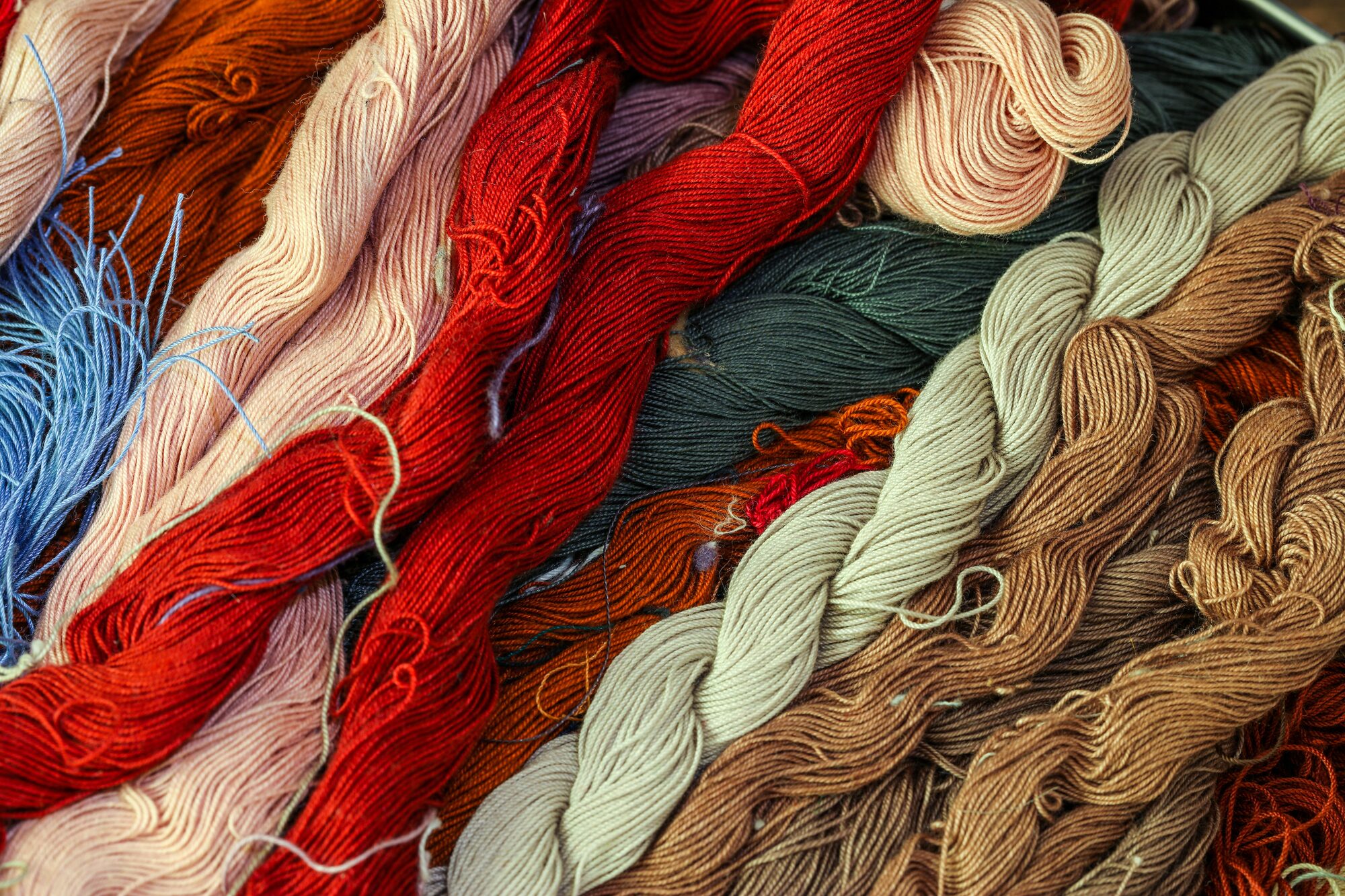
knowledge library / Natural Dyes vs. Synthetic Dyes in Handmade and Antique Rugs
Natural dyes come primarily from plant and insect sources; synthetic dyes are manufactured colorants. In rugs, neither category is inherently more beautiful, stable, safe, sustainable, authentic, or valuable. Color depends on the specific dye, fiber, preparation, mordant or dyeing chemistry, recipe, workmanship, finishing, exposure, and care. Dye origin can inform a rug's history, but appearance alone rarely identifies it with certainty.
“Natural versus chemical” is not a useful distinction because every dye works through chemistry. The more precise comparison is source and composition: a colorant obtained from a biological material such as madder, indigo-bearing plants, cochineal, lac, weld, or walnut, versus a colorant synthesized through industrial chemical processes.
What are natural dyes in rugs?
Natural dyes are colorants obtained primarily from plants and insects and applied to rug fibers through recipes developed for a particular material and color. The source is only one part of the process; cleaning the fiber, controlling the dye bath, and using mordants or other assistants can change the result.
Madder roots can produce a range of reds, oranges, and related tones depending on preparation and mordant. Indigo creates blue through a vat process distinct from many mordant dyes. Insect sources such as cochineal and lac can produce reds and crimsons, while weld, pomegranate, walnut, and other regional materials expand the palette.
“Vegetable dye” is therefore incomplete when an insect colorant is present, and “natural” does not mean unprocessed. Dyeing may involve scouring, heat, repeated baths, acids or alkalis, fermentation, metallic salts, and careful rinsing. Material source does not by itself establish a simple, harmless, or environmentally preferable process.
What are synthetic dyes in rugs?
Synthetic dyes are manufactured organic colorants designed through chemical processes rather than extracted directly from a plant or insect source. They encompass many dye families developed for different fibers, colors, production methods, and performance needs.
The first commercially important synthetic dye appeared in 1856, and new classes followed rapidly. Early aniline colors expanded the available palette and changed textile trade, but “aniline dye” is often used too loosely in rug descriptions. It should not operate as a synonym for every synthetic dye made from the nineteenth century to the present.
Modern synthetic dyes are not one uniform material. Some offer high consistency or strong fastness under defined conditions; others do not. Early examples that faded or bled helped give synthetic color a poor reputation in parts of the rug market, but that history cannot be projected onto every later formulation.
How do natural and synthetic rug dyes compare?
Natural and synthetic dyes differ most clearly in source and production, while their appearance and performance overlap. The individual dye-fiber-process combination matters more than the category name.
| Dimension | Comparison and qualification |
|---|---|
| Source | Natural: Obtained primarily from plant or insect material. Synthetic: Manufactured through chemical synthesis. Both require processing and both are chemical substances. |
| Color range | Natural: Can produce vivid, muted, deep, or pale colors within the possibilities of the source and recipe. Synthetic: Greatly expanded reproducible shades and color families. Neither class has one signature look. |
| Variation | Natural: Source, fiber, mordant, water, and batch variation can create tonal movement. Synthetic: Can be highly controlled, vary between lots, or be deliberately mixed for variation. |
| Lightfastness | Both classes include more and less light-sensitive dyes. Light dose, fiber, concentration, mordant, pollutants, and prior exposure affect the outcome. |
| Wetfastness and transfer | Either class may move, bleed, crock, or remain stable depending on dye selection, fixation, rinsing, fiber, finish, condition, and cleaning chemistry. |
| Age evidence | Natural: Compatible with very early production but does not prove age. Synthetic: An identified dye can establish an earliest possible date if it is original to the rug, but not an exact date. |
| Visual identification | Palette, abrash, tip fading, fluorescence, and saturation may guide questions but do not identify dye class reliably on their own. |
| Analytical identification | Specialists may combine imaging or spectroscopy with chromatography and mass spectrometry, sometimes using a very small sample. Method, sampling location, repairs, and interpretation matter. |
| Safety and sustainability | Neither label proves toxicity, worker safety, water use, pollution control, biodegradability, responsible sourcing, or environmental impact. Those require process-specific evidence. |
| Quality and value | Dye class is one part of whole-rug judgment. Design, color relationships, materials, execution, age, condition, rarity, provenance, restoration, and market context also matter. |
When did synthetic dyes enter handmade rug production?
Synthetic dyes entered textile production after the first commercial synthetic color was developed in 1856, then moved through trade networks at different rates. They are documented in Persian carpets by the later nineteenth century, while natural dye practices continued alongside them.
The transition was neither immediate nor uniform. A city workshop, village, nomadic group, export producer, and local dyer could have different access, preferences, recipes, and customer demands. One rug may also contain several dye systems because colors were sourced at different times or later repairs introduced new yarn.
The date of synthetic-dye invention can become a useful lower boundary only when analysis identifies a particular colorant and the yarn is demonstrably original. A synthetic dye in a repair says when the repair could have occurred, not when the rug was woven. The absence of a detected synthetic dye does not prove an early date.
Are natural dyes more colorfast than synthetic dyes?
Natural dyes are not categorically more colorfast than synthetic dyes. Fastness belongs to a specific dye on a specific fiber, prepared and applied in a specific way, then exposed to particular light, moisture, pollutants, wear, and cleaning.
Lightfastness describes resistance to change under light. Wetfastness concerns behavior when exposed to water or cleaning solutions. Crocking is color transfer by rubbing. A dye can perform well in one respect and poorly in another, so “colorfast” should name the test or condition rather than function as a blanket promise.
Some traditional dyes on wool can be relatively stable; others can be highly light-sensitive. Some early synthetic colors were fugitive or poorly fixed; later synthetic systems can be engineered for demanding performance. General labels erase precisely the information a conservator, cleaner, designer, or owner needs.
How do dyes change as a rug ages?
Dyes change through light, oxidation, pollutants, moisture, abrasion, cleaning, and interactions among colorant, mordant, and fiber. Aging does not reliably separate natural from synthetic color because both categories contain very different materials.
Fading is cumulative and irreversible. A composite color can also change unexpectedly when one component fades faster than another; a green made from blue and yellow processes may move toward blue if the yellow is more fugitive. Dark areas associated with certain mordant systems can lose pile if the fiber weakens, creating both color and relief.
A mellow palette may be original, deliberately washed, faded, oxidized, soiled, photographed inaccurately, or produced from a mixture of these factors. At WOVEN, we distinguish attractive appearance from supported explanation. A beautiful color does not need an invented aging story.
Can you identify natural or synthetic rug dyes by looking?
Natural and synthetic rug dyes usually cannot be identified with confidence by sight alone. Visual examination can locate questions and select areas for closer study, but the same hue, saturation, abrash, or fading pattern may arise from different colorants and processes.
Review the rug under controlled, neutral light and compare the full face, reverse, protected areas, pile direction, repairs, and each occurrence of the same nominal color. Note whether a shade belongs to the original weave, a later reweave, an applied surface treatment, or a photograph's color balance.
Rules such as “electric color means synthetic” or “soft color means natural” are unreliable. A natural dye can be brilliant; a synthetic dye can be restrained. Even ultraviolet response and simple spot reactions can be ambiguous or damaging. They should not be used as owner-administered proof.
How are rug dyes identified scientifically?
Rug dyes are identified scientifically by comparing chemical or spectral evidence with known reference materials, often through a sequence of non-invasive survey and targeted microanalysis. No single method answers every dye question.
Reflectance or fluorescence methods can help map colorants without removing material, while chromatography and mass spectrometry can separate and identify compounds from very small samples. Surface-enhanced Raman spectroscopy and related methods may identify selected organic colorants at extremely low concentrations.
Sampling is an interpretive decision. The analyst must know whether the yarn is original, faded, contaminated, repaired, or chemically treated and whether the sample represents one color area or the rug as a whole. Results may identify a compound, a likely biological source, a synthetic dye family, or only a bounded group; uncertainty should remain visible.
Does abrash prove that a rug uses natural dyes?
Abrash does not prove natural dyes. It describes tonal variation within an intended color, often connected to yarn or dye-batch differences, and it can occur with natural dyes, synthetic dyes, undyed fibers, or deliberate color blending.
Hand-spun yarn and small-batch dyeing can produce subtle variation, but modern production can create the same visual rhythm intentionally. WOVEN's Modern Abrash category makes the contemporary design connection explicit without turning the effect into an age or dye certificate.
Uniform color is equally inconclusive. A well-controlled natural-dye batch can be consistent, while synthetic yarn from separate lots can vary. Abrash should be documented as a color relationship and then evaluated with construction, material, history, and, when necessary, analysis.
Do natural dyes make an antique rug more valuable?
Natural dyes do not automatically make an antique rug more valuable. Verified dye information can strengthen historical understanding, but value depends on the whole object and the market context in which it is being judged.
For a rare or important rug, original colorants consistent with the attributed place and period may be meaningful. Yet design, color harmony, scale, materials, execution, condition, rarity, provenance, restoration, and demand can outweigh a simple dye label. A poorly designed or severely compromised rug does not become exceptional because a colorant is natural.
WOVEN's antique Persian, antique Turkish, and vintage rug collections span different periods and traditions. Dye conclusions for any individual rug should be tied to object-specific evidence rather than the category name.
How should designers evaluate rug color?
Designers should evaluate rug color as a system of relationships under the light and scale of the intended room, not as a natural-versus-synthetic binary. A palette succeeds through proportion, contrast, depth, material, and change across the full surface.
View the whole rug from every major approach, then compare details in morning, afternoon, and electric light. Pile direction, sheen, height, and wear can make one dye appear lighter or deeper. Adjacent stone, wood, metal, upholstery, and wall color can shift the eye's reading further.
WOVEN's contemporary rugs and antique recreations offer different design contexts from antique rugs, but neither category name identifies a dye system. Request product-specific color, material, care, and production information when those facts affect a specification.
How should naturally and synthetically dyed rugs be cared for?
Naturally and synthetically dyed rugs should both be protected from unnecessary light, moisture, harsh chemistry, and untested cleaning. Care should follow the individual rug's fiber, construction, color stability, condition, prior treatment, use, and environment.
Reduce direct and prolonged sunlight rather than assuming one dye class can tolerate it. Rotate only when the rug's construction, condition, room, and furniture allow; rotation redistributes exposure and wear but does not reverse damage. Document current color and protected areas before changing placement.
Cleaning requires colorfastness assessment by an appropriate professional when the rug is valuable, antique, fragile, repaired, strongly colored, previously treated, or compositionally uncertain. Dye transfer during moisture testing or washing signals risk. Do not use household chemicals, steam, bleach, or an online recipe to determine or “set” a dye.
What misconceptions about rug dyes should buyers avoid?
The most common rug-dye misconceptions turn source labels into guarantees. A responsible description states what is known, how it is known, and what remains uncertain.
- “Natural means chemical-free.” All dyeing is chemical, and traditional processes may use mordants, acids, alkalis, salts, heat, and repeated baths.
- “Natural dyes are always muted.” Natural colorants can produce vivid as well as restrained colors.
- “Synthetic dyes are always bright and unstable.” Synthetic dyes cover many families and performance levels.
- “Abrash proves natural dye.” Tonal variation can occur or be designed in either dye system.
- “Synthetic dye proves a rug is modern.” Synthetic dyes entered rug production in the nineteenth century, and a later repair may contain them.
- “Natural dye proves an antique.” Natural dyes remain in contemporary use.
- “Color can identify the dye.” Appearance guides examination but rarely provides chemical identification.
- “Natural is automatically safer or more sustainable.” Those claims require evidence about materials, mordants, water, energy, waste, exposure, and labor.
- “Dye class determines value.” Value is a whole-object and market judgment.
How does WOVEN assess dye claims in a rug?
WOVEN assesses dye claims through six connected lenses: color, material, process, exposure, condition, and evidence. The framework begins with what the rug visibly presents and increases confidence only when independent clues agree.
- Color: What are the hue, saturation, value, variation, palette relationships, and distribution across the design?
- Material: Which fibers and yarn structures carry the color, and are naturally colored fibers part of the effect?
- Process: What preparation, mordant, dyeing, rinsing, weaving, finishing, washing, or later treatment is documented?
- Exposure: How have light, pollutants, moisture, wear, storage, and room conditions changed the surface?
- Condition: Which colors belong to original yarn, fading, corrosion, stains, bleeding, repairs, or applied alteration?
- Evidence: Is the conclusion based on visual opinion, reliable documentation, comparison, specialist examination, or analytical results?
The strongest description may be specific, qualified, or deliberately limited: “madder identified by analysis,” “synthetic red in a later repair,” “color consistent with a traditional palette but untested,” or simply “dye class unknown.” Precision includes knowing when not to claim more.
What matters most when comparing natural and synthetic rug dyes?
The most important distinction is not which dye label sounds better, but how color was made, how it behaves, and what the evidence supports. Natural and synthetic dyes both belong to rug history and contemporary practice. Judge the palette within the whole rug, separate appearance from identification, protect every color from avoidable damage, and treat certainty as something earned through documentation and analysis.