knowledge library / Khotan and Samarkand Rugs: Understanding the Crossroads of Central Asian Design
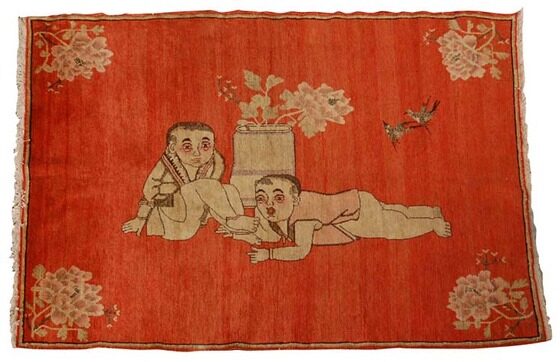
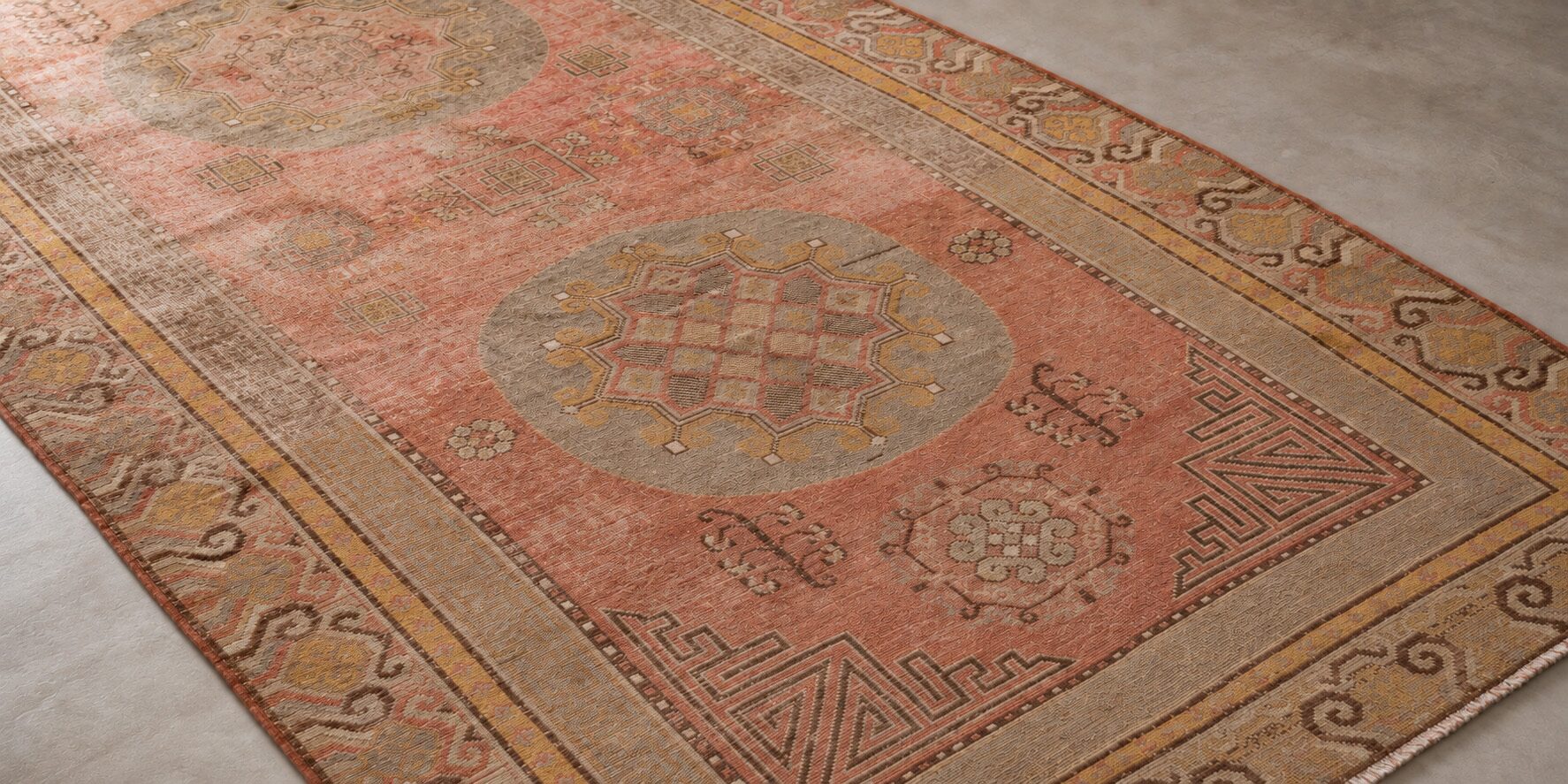
Khotan and Samarkand rugs are related terms, but they are not precise synonyms. Khotan names an oasis and weaving center in the southern Tarim Basin, in present-day Xinjiang, China. In the rug trade, Samarkand became a broad label for carpets associated with Khotan and neighboring centers. The most responsible reading begins with geography, then tests the label against composition, structure, materials, condition, and documentation.
Khotan Is a Place; Samarkand Is Often a Trade Label
A Khotan rug is a carpet attributed to Khotan, an oasis on the southern edge of the Taklamakan Desert and a historic center of exchange across the Tarim Basin. Samarkand is a different city, in present-day Uzbekistan, far to the west. Although carpets are woven in Uzbekistan, the term Samarkand rug has long been used in the international carpet market for a group of carpets now more often assigned to Khotan, Yarkand, Kashgar, or the wider Tarim Basin.
That distinction changes how a catalog description should be read. On an antique label, Samarkand may preserve the language of an earlier market rather than document the loom's location. Khotan is geographically more specific, but even that attribution can be a reasoned classification rather than a recorded fact. A rug can fit the Khotan tradition without carrying an unbroken account of where, when, and by whom it was woven.
The following terms therefore do different jobs:
| Term | What it usually communicates | What it does not prove |
|---|---|---|
| Khotan | A place-based attribution to Khotan or its weaving tradition | A documented workshop, date, fiber, dye source, or ownership history |
| Samarkand | Often a historical trade or market label for Tarim Basin carpets | Manufacture in the city of Samarkand |
| East Turkestan | A historical regional term used in older carpet literature for the Tarim Basin and surrounding area | A precise modern political designation or exact weaving town |
| New Khotan | A contemporary rug made in the design vocabulary associated with antique Khotan carpets | Antique age or manufacture in Khotan |
WOVEN's category structure reflects this layered usage: the broader antique Samarkand collection preserves a familiar market term, while the Khotan collection offers the more specific design and attribution path.
Why Do Khotan Rugs Combine Several Design Languages?
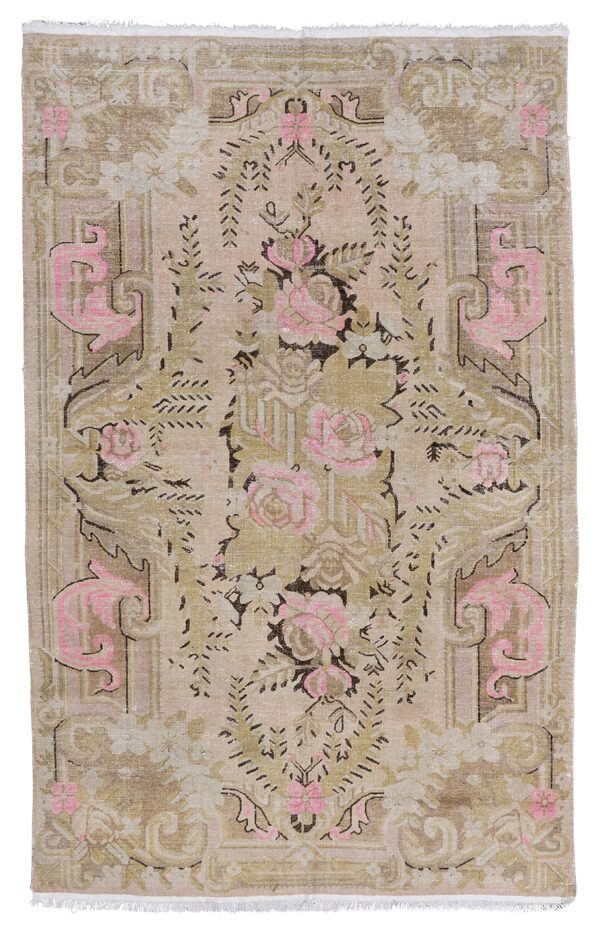
Khotan rugs combine several design languages because the southern Tarim Basin connected communities, goods, religions, and visual traditions moving between China, Central Asia, Iran, and the Indian subcontinent. The result is not a random collage and should not be reduced to the phrase “Silk Road style.” These carpets developed a recognizable local grammar by selecting, redrawing, and repeating forms that also appear in neighboring artistic worlds.
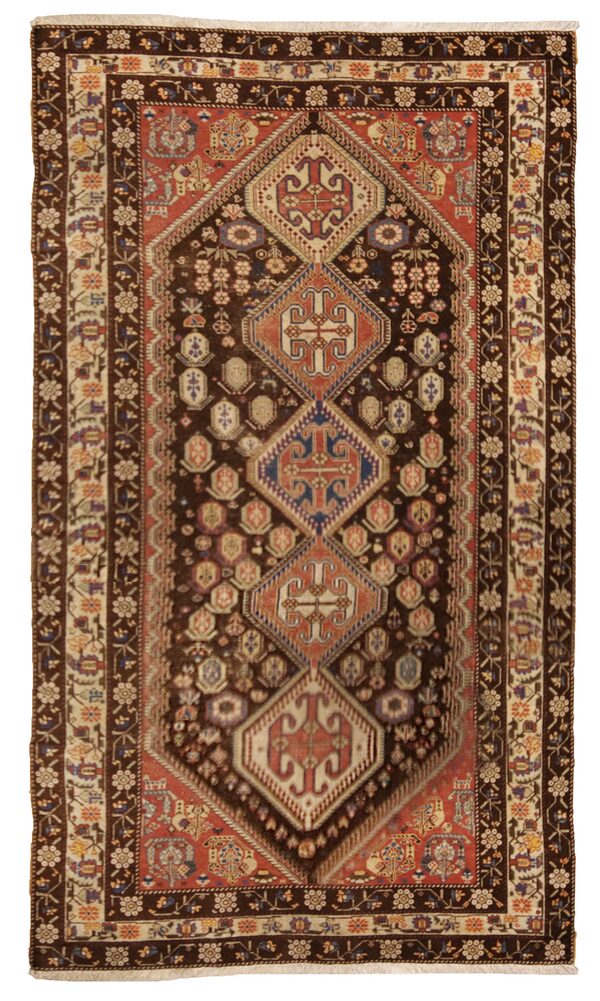
Chinese or Mongolian affinities may be strongest in a border, cloud-like fret, lotus form, or palette relationship. Iranian, Central Asian Turkic, or Mughal affinities may be more visible in a field layout, lattice, vase, or repeating medallion. Yet a motif's resemblance to another tradition does not identify a single route of transmission, and it does not make the rug Chinese, Persian, Indian, or Turkman. The whole composition matters more than any isolated shape.
This is the central misconception to avoid: cultural exchange does not erase local authorship. A Khotan carpet can contain widely traveled forms and still resolve them through its own spacing, angular drawing, border rhythm, and material character.
How Can You Read the Design of a Khotan Rug?
The design of a Khotan rug is best read from large structure to small motif. At WOVEN, we begin with the field's organization, then study how the border controls it, how the drawing moves, and where color creates emphasis. This sequence prevents a familiar pomegranate, cloud form, or medallion from overwhelming the evidence of the rug as a whole.
Begin With the Field Architecture
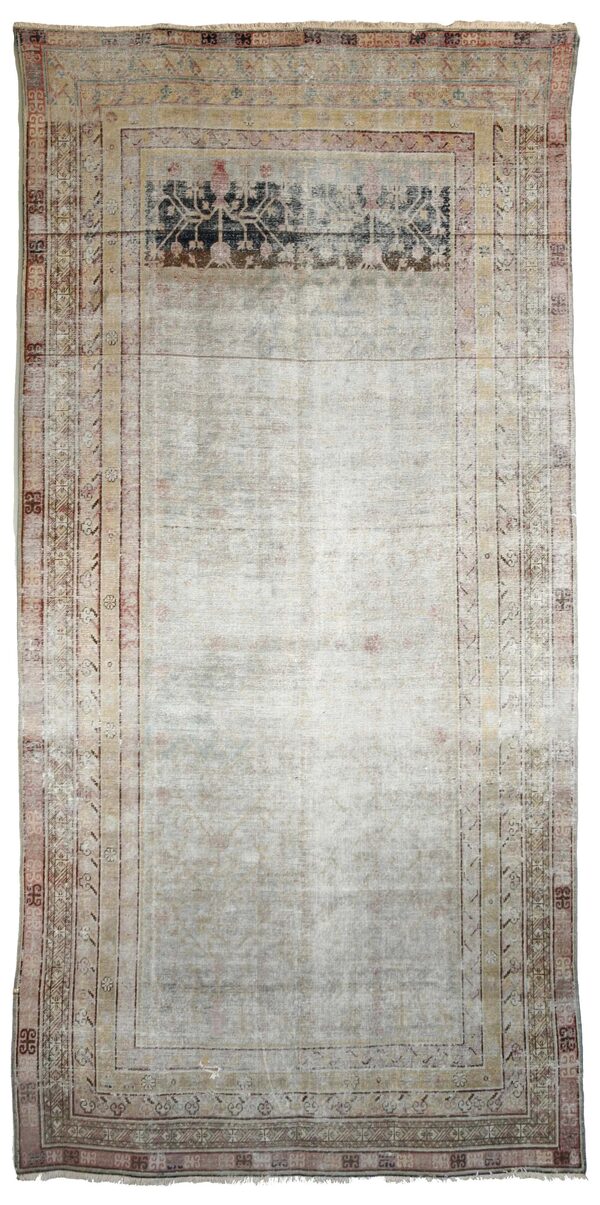
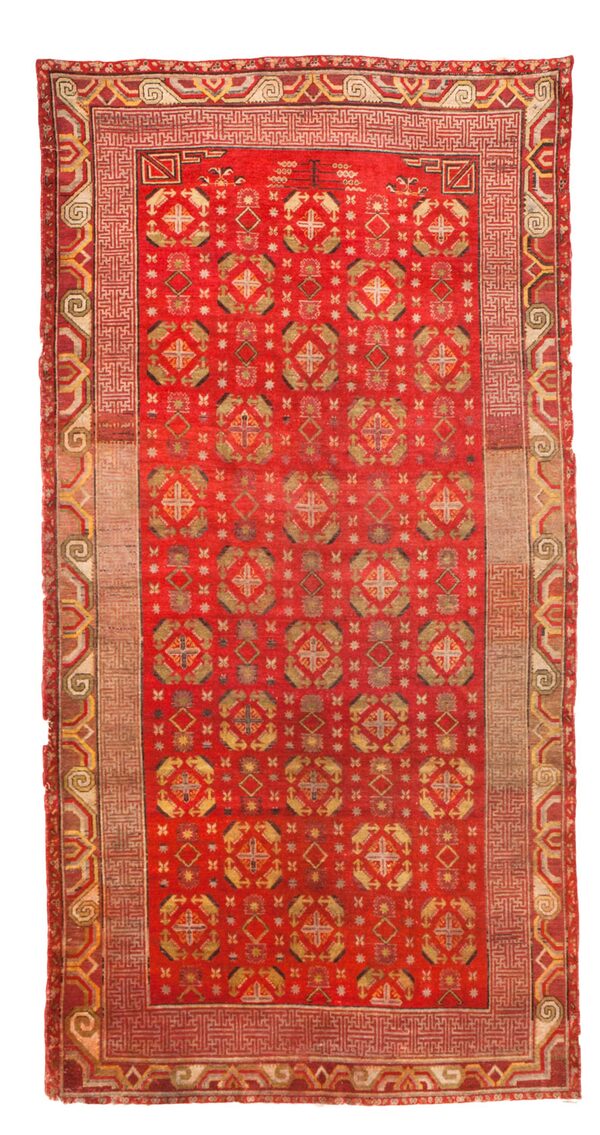
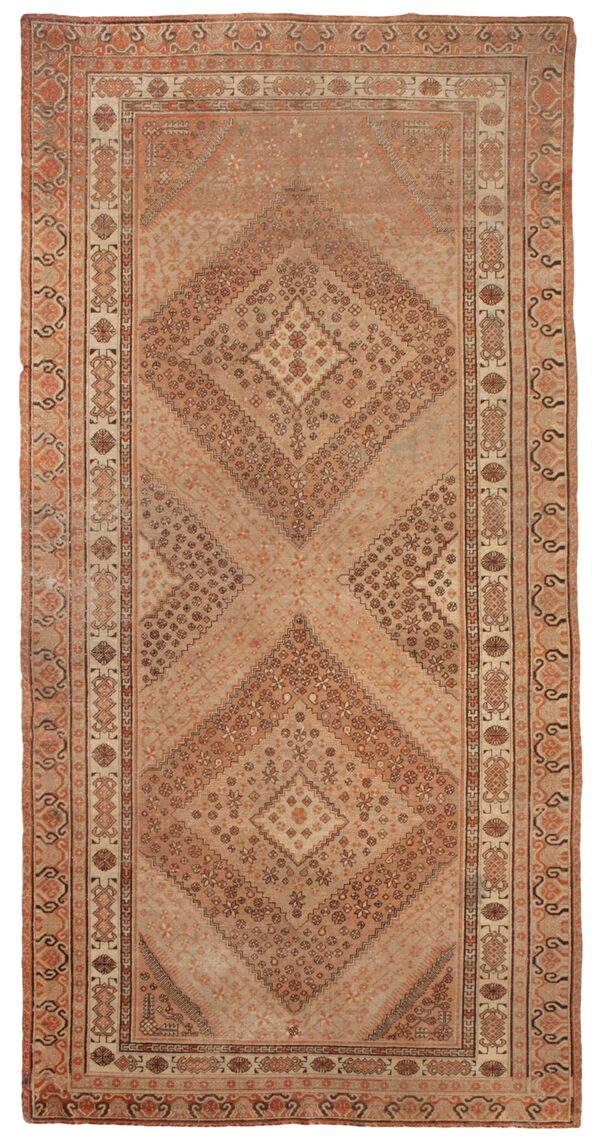
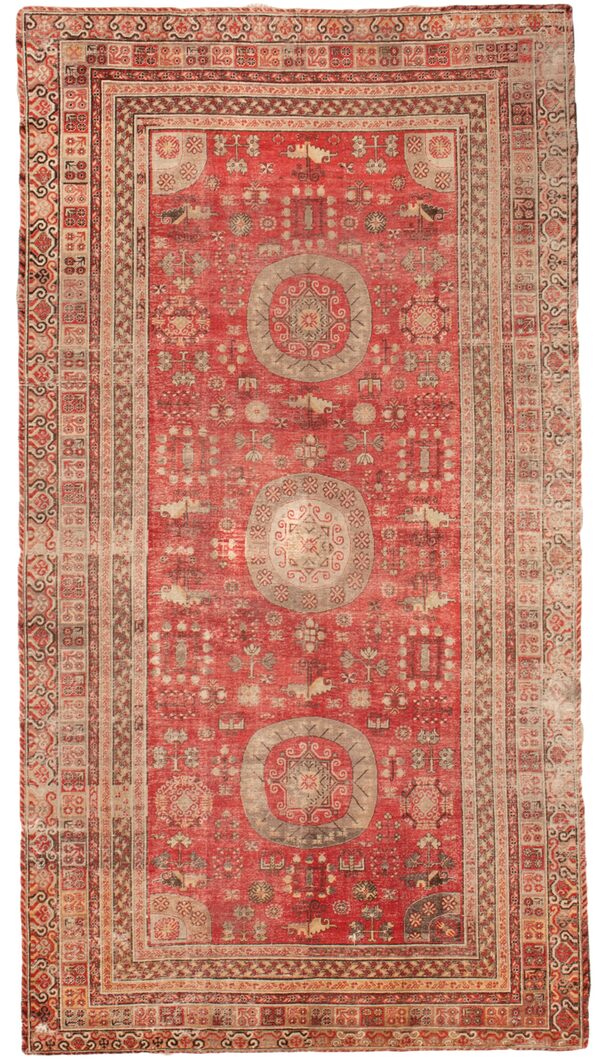
Khotan fields commonly organize space through a centered medallion, repeated roundels, a compartment or lattice system, a vase-and-plant arrangement, or a directional prayer format. None is a universal template. What links many examples is the balance between strong geometry and intervals of quieter ground.
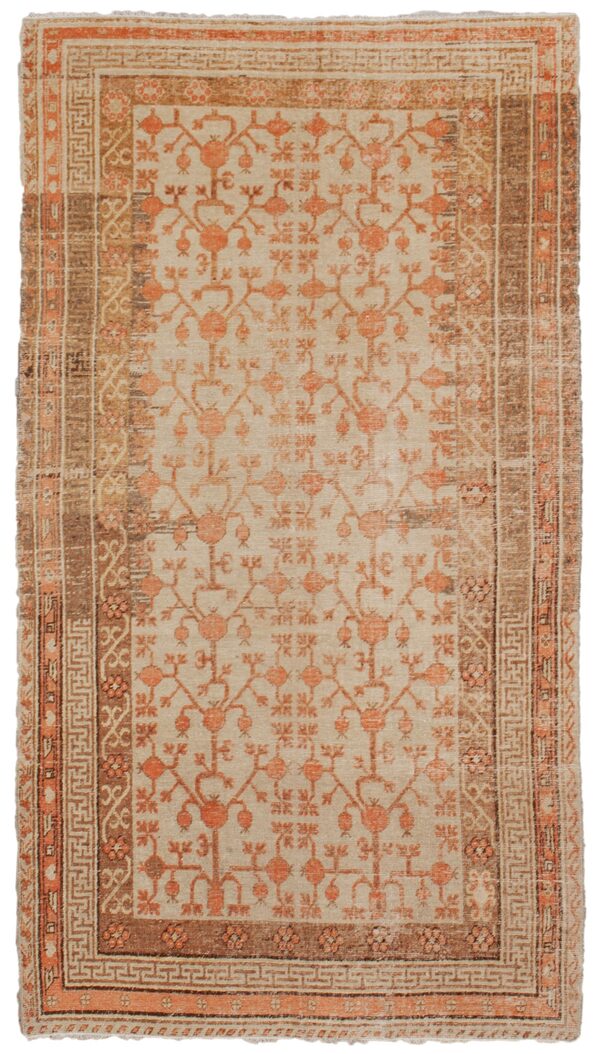
A single vase-and-pomegranate tree can make the carpet read vertically and ceremonially. Repeated pomegranate forms create a measured procession. A medallion or coffered layout produces a steadier, more architectural center. These are compositional effects first; symbolic interpretation requires separate evidence.
Read the Border as a Second Design System
The border of a Khotan rug often carries a denser or more geometric rhythm than the field. Fret-like forms, reciprocal shapes, floral meanders, cloud-derived patterns, narrow stripes, and repeated devices may sit beside one another. Rather than treating this as excess, read the border as a frame that compresses energy around a more open center.
This field-border contrast is one reason Khotan rugs work so well in rooms that need both presence and air. The center can hold furniture without losing every important detail, while the perimeter remains legible around the arrangement.
Treat the Pomegranate as a Design, Not a Password
The pomegranate is one of the most recognizable forms in Khotan carpets, often growing from a vase, branching as a tree, or repeating within a lattice. It can be described confidently as a visual feature. Its meaning cannot be decoded with equal certainty.
Pomegranates have carried associations with fertility, abundance, continuity, and sacred life in many cultures. That broad history does not prove what a particular weaver, workshop, patron, or owner intended. Unless a rug has unusually strong documentation, motif naming should remain separate from claims about symbolism.
What Can Materials and Construction Tell You?
Materials and construction can support a Khotan attribution, but they rarely settle it alone. Documented Tarim Basin carpets include asymmetrically knotted pile on cotton foundations, and surviving examples use wool, silk, or combinations of fibers. Some exceptional carpets also include metal-wrapped threads. That range makes universal material formulas unreliable.
The reverse of the rug may reveal knot structure, foundation material, weft arrangement, repairs, and differences between original and later work. Those details should be considered with the drawing and handle of the entire object. A silk pile is not proof of Khotan origin; a cotton foundation is not proof of a particular age; and a coarse or fine weave is not, by itself, a verdict on artistic quality.
Color requires the same restraint. Soft apricot, yellow, red, blue, green, brown, and ivory relationships appear across the group, but palette alone cannot establish origin or natural dyes. Fading, wear, chemical change, photography, and later treatment can all alter what the eye sees. Fiber and dye questions that affect attribution, care, or value require examination by a qualified rug specialist and, when necessary, technical analysis.
Readers interested in material variation can compare the focused Silk Khotan category with the broader antique group, while treating each object record as specific to that rug.
How Should a Khotan or Samarkand Label Be Evaluated?
A Khotan or Samarkand label should be evaluated as a hypothesis with different levels of confidence, not as a complete biography. WOVEN recommends a five-part review that keeps visual appeal and historical accuracy in the same conversation.
- Name the label precisely. Record whether the seller uses Khotan, Samarkand, Yarkand, Kashgar, East Turkestan, or a combined term. Ask whether the name indicates a documented origin, an expert attribution, or a market category.
- Map the composition. Identify the field system, border sequence, direction, spacing, and motif scale before interpreting individual devices.
- Inspect the structure. Examine the back, ends, sides, foundation, pile, knotting, and any mixed materials. Photographs can begin this step but do not replace handling.
- Separate age from condition. Wear, fading, corrosion, repairs, reduced ends, and replaced areas may affect appearance and use. They do not provide a reliable date by themselves.
- Test the documentation. Compare invoices, collection labels, prior publications, restoration records, and dated photographs. Earlier terminology can be valuable evidence of market history even when the geographic attribution is later revised.
This framework also protects against false certainty. An object may be securely placed within a broad Tarim Basin group while its exact town remains unresolved. A careful description can say so without diminishing the carpet.
How Do Khotan Rugs Work in Contemporary Interiors?
Khotan rugs work in contemporary interiors when their field density, border energy, color hierarchy, and scale answer the architecture of the room. The label may guide discovery, but the composition should guide selection.
For a room with sculptural furniture, an open field or large single plant can provide visual calm while retaining a strong vertical gesture. In a long room, repeated roundels, lattice units, or parallel plant forms reinforce procession without behaving like a conventional allover pattern. A more compartmentalized design can bring order to an open seating plan, while a vivid border can establish an edge around furniture placed largely within the field.
Surface is equally important. A worn antique may soften contrast and make complex drawing recede; a silk surface can change more visibly with light and viewpoint; a newer interpretation may deliver clearer pattern and a different performance profile. WOVEN separates those choices rather than treating reproduction and antique as interchangeable. The New Khotan collection translates the vocabulary into contemporary production, while the antique categories preserve the material and historical evidence of individual objects.
Before specifying any example, view it from three distances: across the room for architecture, at furniture distance for pattern and color, and close enough to assess surface and condition. Then compare those observations with the rug's dimensions, placement, traffic, light, and care requirements.
Khotan and Samarkand Are Related, but the Difference Matters
Khotan and Samarkand rugs belong to the same market conversation, but the names carry different levels of geographic precision. Khotan identifies an oasis and weaving tradition; Samarkand often preserves a broader historical trade label. The strongest interpretation does not stop at either name. It connects geography with composition, construction, condition, and documentation, then lets the rug's actual design determine how it belongs in a room.