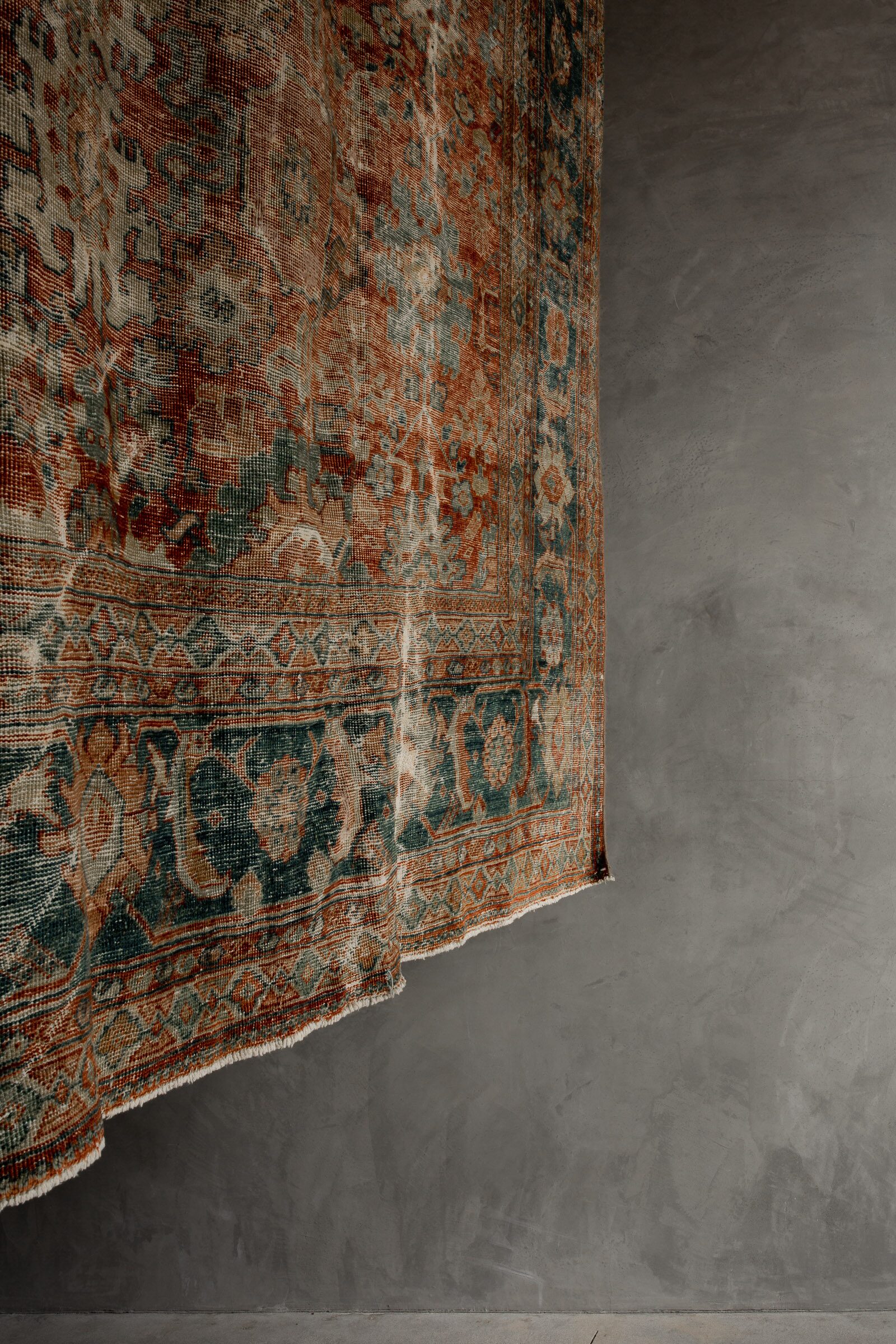
knowledge library / How to Evaluate an Antique Rug
An antique rug should be evaluated as a whole object, not by age, knot count or appearance alone. A sound assessment brings together evidence of origin and date, physical condition, materials and construction, quality of design and execution, rarity, provenance and the market relevant to the purpose of the valuation. Each factor can strengthen or limit the others.
That process can guide a purchase, but it is not a formal appraisal. Exact age, attribution, restoration history and value may require examination by an antique-rug specialist, textile conservator or qualified appraiser.
What does it mean to evaluate an antique rug?
Evaluating an antique rug means forming several related judgments without collapsing them into one. You are asking what the rug may be, how confidently its age and origin can be described, how well it was conceived and made, what has happened to it, how unusual it is and what it may be worth in a defined market.
At WOVEN, we find it useful to separate five lenses: identity, integrity, execution, distinction and context. A rug can be visually exceptional yet structurally fragile. It can be rare but poorly restored. It can be beautifully made without being especially scarce. It can also be right for a room without belonging to the most collectible tier of its type.
| Evaluation lens | What it asks | What does not answer it alone |
|---|---|---|
| Identity | What evidence supports the proposed origin, type and date? | A dealer label, motif, color or knot name |
| Integrity | How much original structure remains, and is the rug stable for its intended use? | An attractive surface or the absence of obvious holes |
| Execution | How well do design, materials, structure and finish work together? | Knot count, fineness or silk content by itself |
| Distinction | How unusual and desirable is this example within the correct comparison group? | Age or uniqueness in the literal sense |
| Context | Which market, purpose, date and intended use shape the judgment? | An asking price or an unrelated auction result |
How Do You Authenticate an Antique Rug?
Authenticating an antique rug means testing its proposed identity and age against the object and its documentation. Begin with photographs of the full front and reverse, edges, ends, and any repairs, then compare the construction, materials, design, and available history. No single motif, knot, faded color, or sign of wear proves authenticity. Where the attribution matters to a purchase or collection, seek examination by an antique-rug specialist.
- Identify the claim. Record the proposed origin, weaving tradition, date range, and the seller's basis for each. Separate an observed feature from an inferred attribution.
- Read the complete object. Compare front and reverse, foundation and pile, borders and ends. Look for areas where repair or alteration may change the evidence.
- Test the age attribution. Review dated records and securely identified comparisons. Treat age as a supported range when the evidence does not justify a precise year.
- Record condition separately. An authentic antique may be heavily repaired; an intact rug may be recent. Condition and authenticity answer different questions.
- Define the appraisal need. If a monetary valuation is required, ask a qualified appraiser to state its purpose, date, market, and supporting comparisons.
A useful review separates four outputs: identification describes what the rug is; age attribution estimates when it was made; a condition report describes its present state; an appraisal addresses value for a stated purpose. One document does not automatically establish all four. Keep the photographs, record of repairs, and attribution reasoning together so a future reviewer can understand both the conclusion and its limits.
How can you estimate an antique rug's age?
An antique rug's age is best expressed as a supported range, unless reliable documentation or an integral inscription provides stronger evidence. Specialists compare the rug's structure, materials, design vocabulary, proportions, palette, finish and signs of use with securely identified examples. No single visual clue functions as a clock.
Begin by asking how the date was reached. Is it documented in an earlier invoice, collection record, exhibition history or publication? Is the proposed date consistent with the foundation, pile, weave and finishes? Does the design belong plausibly to the named place and period? Have later repairs, reduced ends, replaced borders or recoloring changed the evidence?
Wear can be consistent with age, but it does not establish age. Artificial distressing, hard use, poor storage and abrasive cleaning can alter a newer rug, while an older rug may survive in unusually full condition. The reverse often preserves clearer evidence of structure and color, but it should be read with the front and the object's history rather than treated as a standalone authenticity test.
How should condition be assessed?
Antique-rug condition is the present state of the pile, foundation, edges, ends, color and repairs, together with the likelihood that existing weaknesses will progress. A useful condition review distinguishes surface character from structural loss and active risk. It also considers the proposed setting, because a stable display textile and a rug expected to support daily circulation face different demands.
Inspect the entire front in even light, then examine the reverse. Look for uneven pile, exposed foundation, holes, tears, brittle areas, missing or reduced ends, weakened selvages, stains, dye migration, moth grazing and earlier repairs. Compare suspicious areas from both sides. A patch, reweave or overcast edge is not automatically disqualifying; its extent, materials, visual integration, structural effect and disclosure matter.
Condition should change the use plan as well as the price conversation. A beautiful but vulnerable rug may need lower traffic, better support or textile-conservation advice. Cleaning, repair and restoration should follow an individual assessment, especially when fibers, dyes, prior treatments or structural stability are uncertain.
What defines craftsmanship in an antique rug?
Craftsmanship is the quality of the relationship among design, material, structure and execution. It is not a universal race toward the smallest knot. A finely knotted workshop carpet and a boldly drawn village or nomadic weaving may pursue different visual and structural aims; each should be judged within an appropriate tradition and comparison group.
Look first at the whole composition. Does the field hold together at viewing distance? Do borders contain or energize the design? Are scale, rhythm and negative space purposeful? Then move closer. Study the drawing of curves and diagonals, the transitions between colors, the handling of repeats, the relationship between pile and foundation, the quality of the wool or other fibers and the finish of the sides and ends.
Knot density can support intricate drawing, but more knots do not automatically create a more beautiful, durable or valuable rug. Material labels are equally incomplete. Silk is not inherently superior to wool, natural dye claims cannot be confirmed by appearance alone, and irregularity is not proof of inspired handwork. At WOVEN, the stronger question is whether the maker used the chosen structure and materials with control, character and coherence.
What makes an antique rug rare?
Rarity means scarcity within a meaningful category, not merely that every handmade rug differs. An antique rug may be scarce because few examples of its type survive, because its format or scale is unusual, because its design is an uncommon variant, because its materials or palette are exceptional for the group, or because its history is unusually well documented.
Rarity becomes useful only after the comparison group is correct. A design may be uncommon within one regional type but familiar elsewhere. A large size may be difficult to find and commercially desirable, yet awkward proportions can narrow its audience. A fragment may preserve an important early design but serve a different market from a complete floor rug.
Provenance can add confidence and context when it is supported by records. Ownership stories, labels and old photographs are evidence to verify, not decoration to repeat uncritically. Missing provenance does not make a rug inauthentic, and a distinguished owner does not repair weak attribution or poor condition.
How do age, condition, rarity and craftsmanship affect value?
Antique-rug value emerges from the interaction of object quality and market context. Age can matter, but age without quality, condition, scarcity or demand may contribute little. Strong craftsmanship can attract attention, but extensive structural loss may limit use and price. Rarity can increase desirability, but only when knowledgeable buyers value the feature that is scarce.
Value also depends on the question being asked. A retail asking price, an auction estimate, an auction result, fair market value and insurance replacement value are not interchangeable. Each reflects a different transaction, market, date or purpose. Relevant comparable sales should be close in type, age, size, quality, condition and timing; a record result for a celebrated carpet is not a shortcut to valuing another rug.
| Value reference | What it represents | Main caution |
|---|---|---|
| Retail asking price | The amount offered in a particular retail setting | It is not evidence of a completed transaction |
| Auction estimate or result | A venue-specific estimate or sale outcome | Terms, condition, timing and bidder competition vary |
| Fair market value | A purpose- and date-specific opinion based on the relevant market | The definition and requirements depend on the assignment |
| Insurance replacement value | The expected cost to replace the property with a comparable object | It should not be treated as expected resale proceeds |
A formal value conclusion should identify the rug, the valuation purpose and date, the market considered, its condition and restoration, the evidence for attribution and the comparable information used. For insurance, tax, estate, donation or dispute purposes, seek an appropriately qualified appraiser rather than relying on an informal estimate or online photograph.
A seven-step framework for evaluating an antique rug
A responsible antique-rug evaluation moves from the decision you need to make toward increasingly specific evidence. The sequence below helps prevent a vivid motif, prestigious label or appealing story from controlling the conclusion before the whole object has been examined.
- Define the purpose. Decide whether you are assessing a purchase, room placement, conservation need, insurance value, resale or collection significance. The answer changes the evidence and expertise required.
- Read the whole rug. View it flat and in even light. Assess scale, proportions, composition, palette, visual balance and whether the design remains coherent despite wear or repair.
- Inspect front, back and boundaries. Compare color and structure on both sides. Examine pile, foundation, ends, fringes and selvages, noting loss, distortion, repairs and active weakness.
- Separate fact from attribution. Record measurements, materials and visible construction as observations. Treat origin, date, workshop, community and type as conclusions whose confidence should be explained.
- Judge execution within the right group. Compare drawing, structure, materials and finish with rugs that share a plausible tradition and function. Avoid ranking unlike weavings by knot count alone.
- Test distinction and history. Ask what is genuinely scarce, what documentation survives and whether provenance, inscriptions, repairs and alterations can be corroborated.
- Use the relevant market. Compare like with like, close to the valuation date and within the appropriate venue. Bring in a specialist, conservator or qualified appraiser when the decision carries material financial or preservation risk.
Which common shortcuts lead buyers astray?
The most common evaluation mistakes turn one useful clue into a verdict. An antique label does not prove age. A visible reverse pattern does not prove quality. High knot density does not prove artistic distinction. Natural dyes do not prove authenticity or stability. Wear does not prove age, and restoration does not automatically destroy value.
Another mistake is allowing an origin name to outrank the object. A compelling example from a less fashionable group can offer stronger design, materials and room presence than a compromised rug carrying a prestigious attribution. Labels help organize knowledge, but the rug's actual qualities must carry the judgment.
Finally, purchase price and value should not be confused with guaranteed appreciation. Antique rugs can be culturally significant, visually powerful and deeply satisfying to live with, but future demand cannot be promised. Buy with a clear understanding of condition, use and market context, and let genuine design conviction remain part of the decision.
How should an antique rug be evaluated for a room?
An antique rug intended for an interior must succeed as both an object and a working part of the room. Confirm its actual dimensions and shape, map furniture and circulation, study the palette under the room's light and decide how much wear the condition can responsibly support. The most collectible rug is not automatically the best rug for the setting.
Scale changes the reading. A dense pattern can become a quiet ground beneath furniture, while a spare field may place great emphasis on every table leg. Low pile, fading and abrash can create visual softness, but their causes and structural implications still need separate assessment. Browse WOVEN's antique rug collection to compare broad design traditions, then use the complete antique selection to study differences in scale, palette and format. More focused comparisons are available within antique Persian rugs and antique Turkish rugs.
The best evaluation keeps the factors connected
An antique rug deserves a conclusion built from converging evidence. Age, condition, craftsmanship, rarity, provenance and market context each answer a different question, and none should stand in for the rest. Read the whole design, examine the structure, ask how each claim is supported and define the purpose of any value opinion. That method produces a more useful judgment for collecting, placement and long-term care.