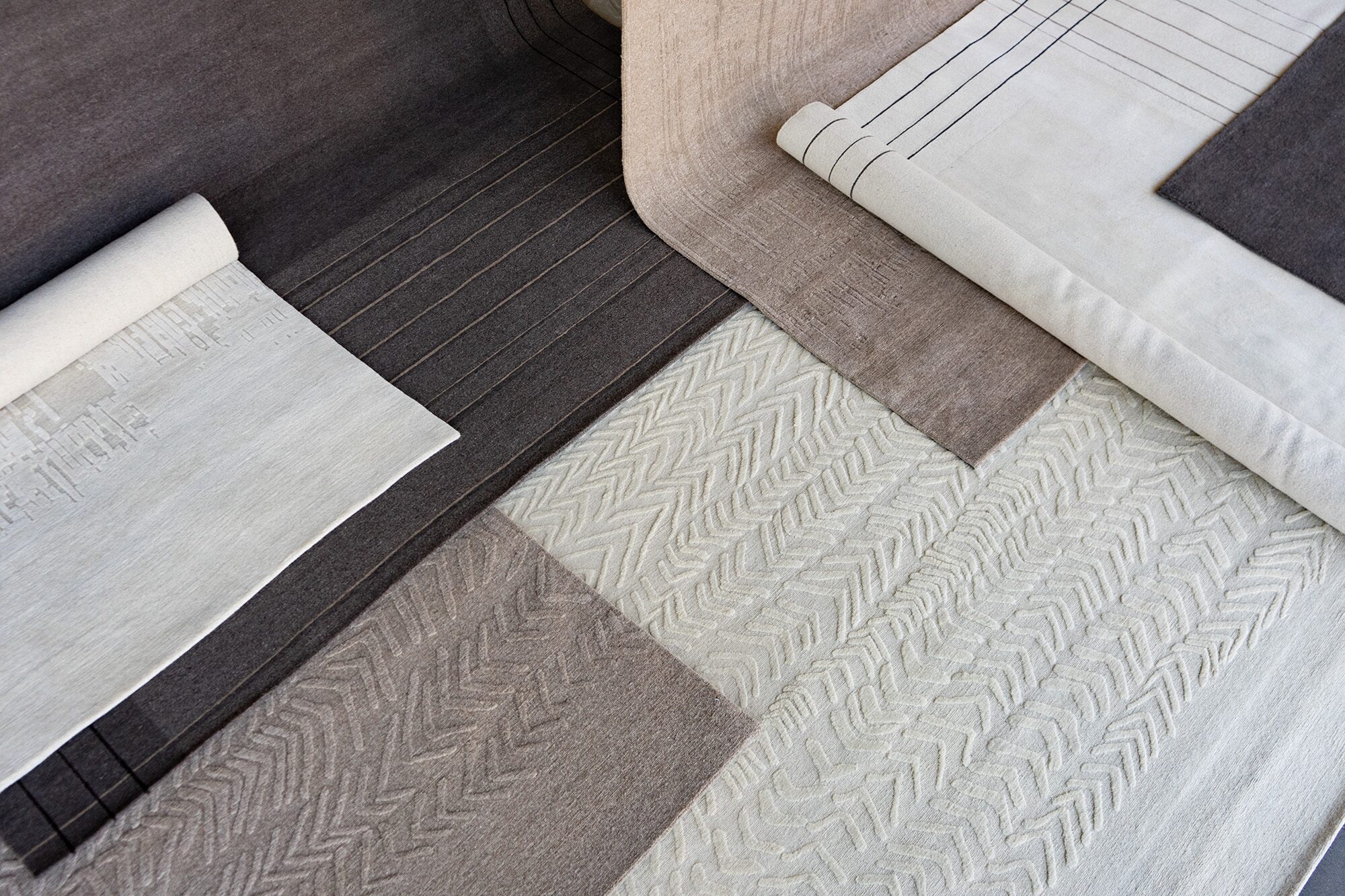
knowledge library / High-Pile vs. Low-Pile Rugs: What Designers Should Consider
High-pile rugs create deeper softness, shadow, and visual volume, while low-pile rugs sit closer to the floor and generally make furniture movement, door clearance, and routine maintenance easier. Neither profile is inherently better, more durable, or higher quality. Designers should compare pile height with density, fiber, construction, room use, furniture, circulation, cleaning, floor conditions, and the way the surface is expected to change.
Pile height is only one part of a rug's finished profile. A dense, low-sheared rug can feel substantial; an open high pile can feel airy rather than heavy; and a flatweave has no upright pile at all. Labels also vary by maker and market, so the actual sample and specification matter more than an isolated term such as “low,” “plush,” or “shag.”
What does rug pile height mean?
Rug pile height refers to the pile yarn rising from the foundation or backing; the stated measurement method matters, especially where yarn bends or loops. Low and high are relative descriptions unless accompanied by dimensions. A pileless flatweave has no upright pile, while the complete rug-and-pad thickness includes more than the pile itself.
The finished experience cannot be read from height alone. Yarn thickness, the amount of yarn packed into an area, knot or tuft structure, twist, shearing, loops, washes, backing, and pad all change how a surface feels and behaves. A measurement may also differ from the relaxed visual height of soft yarn, which bends and compresses in use.
At WOVEN, we treat pile height as a design and specification variable, not a grade. Our Studio WOVEN Texture series is developed through material, knot count, pile height, wash, color, and honest visual assessment together. That combination is the useful unit of judgment.
What is the difference between high-pile and low-pile rugs?
The central difference is surface depth: high pile gives yarn more height to bend, separate, cast shadow, and compress, while low pile holds the surface closer to its structure. That difference affects appearance and use, but every tendency must be checked against the individual rug.
| Dimension | High pile compared with low pile |
|---|---|
| Feel underfoot | High pile: Usually deeper, yielding, and more enveloping. Low pile: Usually firmer, closer, and more direct. Density, fiber, and pad can reverse assumptions about softness. |
| Visual weight | High pile: Builds volume and casts stronger shadow, so even a quiet color can read as a major material gesture. Low pile: Reads as flatter and more architectural, often allowing furniture or pattern to lead. |
| Pattern and color | High pile: Movement and raking light can soften edges and shift apparent color. Low pile: Usually holds fine lines and small motifs more crisply, though sheen and nap can still change the view. |
| Furniture | High pile: Legs may sink farther and leave more visible compression; moving chairs or tables across it can require more effort. Low pile: Usually supports easier sliding and a more level furniture relationship. |
| Doors and transitions | High pile: Requires more clearance and careful review at thresholds and adjacent materials. Low pile: Usually simplifies clearances, but the total rug-plus-pad profile still controls. |
| Walking and wheels | High pile: Can create greater resistance for small casters, mobility devices, carts, and some robotic cleaners. Low pile: Generally offers an easier path, provided the rug and edges remain flat and stable. |
| Routine care | High pile: Gives particles more depth in which to settle and may require equipment selected for long pile. Low pile: Is often easier to inspect and vacuum, but delicate fibers, loops, fringes, or condition can still limit the method. |
| Visible change | High pile: Raking, crushing, matting, and directional tracks may become part of the appearance. Low pile: Abrasion, shading, flattened traffic lanes, and edge wear can still be evident. |
| Best design use | High pile: A tactile focal surface for rooms where softness and depth carry the concept. Low pile: A tailored ground for active furniture, precise pattern, and tighter spatial conditions. |
How does pile height change the visual character of a room?
Pile height changes a room by controlling shadow, reflectance, edge definition, and the apparent thickness of the floor plane. High pile makes the floor feel more dimensional; low pile makes it feel more continuous and precise.
A high-pile solid is not visually neutral simply because it lacks pattern. Long yarns create light and dark movement as they turn, separate, and are walked across. WOVEN's Textured Mohair uses long pile and shag shearing to give color a plush, vintage-inflected surface. The design decision is therefore about changing texture as much as fixed color.
Low pile can sharpen geometry and quiet the floor's physical volume. A low-sheared surface such as WOVEN's Wool Strata can still hold nuanced heathering and depth; “low” does not mean visually flat or materially slight. We often favor this kind of close surface when furniture silhouettes, millwork, or fine pattern need a controlled foundation.
Can I Customize a Rug's Pile Height?
Pile height can be a custom rug design variable, including a level surface or a combination of higher and lower areas, where the selected construction permits it. The available heights, transitions, and finishes must be confirmed for the particular rug. A collection name or another maker's height range does not establish what can be produced for a WOVEN commission.
Specify the finished pile height with units, identify the measurement basis, and agree any tolerance with the maker. For a mixed-pile design, map the height of each area and the transition between them. Yarn, density, shearing, and finishing affect whether the surface reads as crisp relief, soft shadow, or a more relaxed texture.
- At doors: check the total rug and underlay profile against the actual opening.
- Under chairs: assess movement across the high and low areas, not just through the lowest part of the sample.
- At pattern transitions: check whether a narrow raised line remains legible at the agreed yarn and construction scale.
- At approval: record which heights, finishes, and transitions the sample represents, and which conditions require a larger mockup.
A strike-off can approve the sampled surface relationship; it does not by itself establish door clearance, full-room furniture movement, or performance in service. Carry those checks into the drawing and site review. Use the sample and strike-off approval guide to keep physical evidence tied to the final specification.
Record the profile that the room will actually meet
A useful pile-height record separates the maker’s pile measurement from the complete rug-and-pad profile at the floor. Identify the sample, units, method and measurement locations. For a varied surface, record each level and the edge; one measurement through a low channel cannot describe a raised ridge.
| Record | Why it matters |
|---|---|
| Sample and measurement | Quality/sample ID, units, method, relaxed or loaded condition, and date. |
| Surface levels | Pile measurements for each mapped zone; distinguish the pile from the foundation. |
| Complete profile | Rug, edge and proposed pad together; identify floor and attachment assumptions. |
| Room interface | Door’s tightest clearance through its swing; chair-foot or caster position relative to the pattern. |
| Mockup decision | Authorized trial conditions, observations, exclusions, responsible reviewer and remaining checks. |
Do not replace a product measurement with an estimate from a photograph. Where clearance or accessibility governs the decision, have the project team confirm the complete assembly and site condition. The record documents the review; it does not certify compliance or predict service life.
What should designers know about high-low and mixed-pile rugs?
A high-low rug combines two or more surface levels, using relief as part of the composition. It should be evaluated zone by zone because the higher and lower areas may interact differently with light, furniture, feet, cleaning equipment, and wear.
WOVEN's High:Low series uses variations in pile height to turn elemental lines into movement and contrast. The Terrain series intermixes high-pile ridges with dense flatweave, making surface topography the design itself. These are not compromises between two conventional rug types; they are compositions drawn in height.
Mixed pile requires a more specific furniture plan. A chair or table that bridges two levels may sit differently than one positioned within a consistent field. Repeated foot traffic can also change the high and low zones at different rates. Review the largest repeat, the placement of each level, the lighting direction, and the intended furniture footprint on the actual size rather than relying on a small crop.
A subtle height change can matter even when it does not read as shag. Review the actual sample and a section or measurement record for the selected quality. Collection photography alone cannot establish the finished profile at a door, chair foot or exposed edge.
Which pile height works best in a living room, bedroom, or dining room?
The best pile height depends on what moves across the room and what role the rug plays in the composition. High pile is often strongest where touch and visual depth matter most; low pile is often more practical where chairs, doors, wheels, or frequent cleaning define the room.
Living rooms can support either profile
A living room can use high or low pile successfully because seating furniture is often relatively stable. High pile can make a conversational area feel deep and tactile, while low pile creates a quieter plane beneath sculptural furniture and supports easier adjustment of chairs and tables.
Map every furniture foot before deciding. A heavy sofa may compress a deep pile; a light occasional chair may rock if its legs land across different surface levels. If the design relies on a high-low motif, decide whether furniture should avoid, align with, or intentionally cross that relief.
Bedrooms are well suited to tactile pile
Bedrooms often give high pile room to perform because traffic is gentler and the sensation beside the bed can be part of the design. The rug still needs a realistic cleaning route and a stable relationship to bed legs, benches, nightstands, closet doors, and any rolling storage.
A low-pile bedroom rug is a strong choice when the bed is visually weighty, the floor plan is compact, or doors and furniture leave little tolerance. Softness can come from fiber, density, and pad as well as height.
Dining rooms usually benefit from a lower profile
Dining rooms usually favor low pile because chairs repeatedly travel between tucked and pulled-back positions. A closer surface can make that movement more predictable and may make dropped food easier to see, although material, construction, color, and cleaning requirements remain equally important.
A high-pile dining rug raises the specification burden. Review chair movement on an authorized mockup, likely compression and the care plan. The rug must accommodate the intended chair movement; pile height cannot rescue an undersized footprint.
How do doors, furniture, and accessibility affect the choice?
Doors, furniture, and movement often decide pile height before aesthetics do. Designers should check the total finished profile of rug and pad against every moving object and route, then confirm stability and applicable requirements for the project.
Door clearance must be measured at the tightest point through the full swing, not estimated from the nominal pile label. Include the rug's foundation, edge finish, and pad. The same approach applies to floor registers, recessed tracks, drawers, sleeper mechanisms, reclining furniture, and cabinet doors close to the floor.
Small casters and robotic cleaners may resist, climb, stall, or change direction at a soft or uneven surface. Product capabilities vary, so test the proposed device with the actual rug or obtain manufacturer confirmation rather than promising compatibility from pile height alone.
Accessible routes require review of firmness, stability, slip resistance, attachment, edges and changes in level under the applicable project requirements. A loose area rug is not an automatic exemption. Have the responsible design and accessibility professionals evaluate the proposed rug, pad and floor interface and confirm whether the assembly is appropriate for the route.
Does lower pile mean a rug is more durable?
Lower pile does not automatically mean greater durability, just as high pile does not automatically mean fragility. Durability is a whole-rug outcome shaped by fiber, yarn, density, construction, foundation, edges, finishing, placement, soil, moisture, maintenance, and the type of traffic.
Pile height changes the form that wear may take. Long pile can rake, crush, tangle, or mat; a close pile can abrade, shade, flatten, or expose wear along repeated routes. Furniture can compress either profile, and moving a chair repeatedly across one area can be more consequential than ordinary foot traffic.
At WOVEN, we would not approve a rug for a room from “high pile” or “low pile” alone. Ask for the construction, fiber, intended application, sample behavior, care guidance, and any project-specific performance information. For an antique, vintage, delicate, or condition-sensitive rug, individual inspection should override generic pile advice.
Is a low-pile rug always easier to clean?
A low-pile rug is often easier to inspect and maintain routinely because soil has less surface depth in which to settle, but “easier” is a tendency, not a care instruction. Fiber, dye, loops, fringe, backing, condition, and the type of soil can matter more than height.
Vacuum equipment and settings must follow guidance for the individual rug. Long yarns, loops, fringe, fragile areas and unstable repairs can change what is appropriate. Seek specialist advice for valuable, damaged or uncertain textiles; stop if yarns pull, distort or become caught. A low profile does not make an aggressive brush safe.
Furniture should be lifted rather than dragged across either pile. Suitable support under furniture can distribute pressure, and periodic review can reveal compression or abrasion before it becomes severe. Significant stains, unstable dyes, structural damage, valuable rugs, and uncertain materials warrant professional assessment rather than improvised cleaning.
Does high pile improve warmth and acoustics?
High pile can make a room feel warmer and visually softer, but pile height alone does not establish thermal or acoustic performance. Rug area, mass, density, foundation, underlay, floor assembly, wall and ceiling surfaces, furnishings, gaps, and frequency all influence the result.
Textile floor coverings can reduce footfall hardness and contribute sound absorption, yet two rugs of different heights may not compare as expected if their density and backing differ. If an acoustic target is part of a commercial, hospitality, music, or multifamily brief, use tested assemblies and qualified acoustic guidance. A tactile impression is not a laboratory rating.
How should designers compare high-pile and low-pile rug samples?
Designers should compare rug samples as working surfaces, not static swatches. Review each sample flat, in project light, under pressure, beside the proposed finishes, and against the actual movements the room requires.
- Confirm the terms. Request the finished pile or total profile and ask how the maker measured it. Note whether the surface is cut, looped, sheared, shagged, carved, or mixed.
- Read the structure. Turn the sample over and identify the foundation, backing, edge, and direction. Height without construction context is incomplete.
- Assess recovery within an agreed scope. On an authorized sample, use only a maker-approved, non-damaging comparison. Record the conditions and immediate observation; do not interpret a hand press as a long-term performance test.
- Change the light. View from opposite directions and at a low angle. Long or lustrous pile can shift apparent color; low pile can also show nap and sheen.
- Review movement safely. Agree a suitable mockup with the supplier for chair, caster or equipment trials. Use an authorized sample large enough to represent transitions; do not run an improvised trial on a valuable or fragile rug.
- Plan the pad and floor interface. Review the complete thickness, edge support, grip, floor compatibility, and transition to adjacent materials.
- Match the care plan. Confirm routine cleaning equipment, likely soils, specialist needs, and who will maintain the rug.
- Model change. Decide whether compression, tracking, variation, and patina will support the design concept or undermine it.
What misconceptions lead to a poor pile-height decision?
The most common pile-height misconceptions treat one visible feature as a complete performance specification. A better decision separates height from the many material and structural variables that produce the finished rug.
- “High pile is always softer.” Softness also depends on fiber, yarn, density, finishing, and pad.
- “Low pile is always commercial.” A low-sheared rug can be nuanced, tactile, and highly refined.
- “Thicker means better quality.” Height does not prove materials, construction, execution, longevity, or value.
- “Low pile cannot show wear.” Close surfaces can reveal abrasion, shading, traffic lanes, and edge wear.
- “High pile hides dirt.” Concealing particles from view does not remove them and can make condition harder to assess.
- “Any vacuum works if the suction is strong.” Brush action, airflow, height, yarn length, fringe, loops, and condition all matter.
- “A high-low rug behaves like one uniform surface.” Different levels can meet furniture, light, traffic, and cleaning equipment differently.
- “Pile determines acoustics.” The whole floor and room assembly governs acoustic performance.
How does WOVEN evaluate pile height for a room?
WOVEN evaluates pile height through six connected questions: what the surface should communicate, what must move across it, how the rug is built, where it will live, how it will be maintained, and how acceptable change will look over time.
- Surface: Should the rug read as plush topography, subtle relief, a tailored plane, or a crisp pattern field?
- Movement: Which feet, chair legs, casters, doors, carts, and bodies will cross or compress it?
- Structure: How do fiber, density, yarn, construction, foundation, edge, and pad create the profile?
- Room: Does the pile support the furniture, light, circulation, scale, and adjacent finishes?
- Care: Can the owner or operator maintain the actual surface with appropriate equipment and specialist support?
- Change: Will raking, compression, shading, abrasion, or patina feel natural within the design?
This framework keeps pile height in proportion. High pile can be the room's most expressive material; low pile can be the exact surface that lets everything else come into focus. The successful choice is the one whose beauty and behavior belong to the same brief.
Should you choose a high-pile or low-pile rug?
Choose high pile when tactile depth, shadow, and a changing surface are central to the room and its furniture, movement, and care can support them. Choose low pile when a tailored profile, clear pattern, easier movement, or tight clearances matter more. In either case, specify the complete rug rather than the label: sample it, test its interfaces, plan its maintenance, and decide how it should age.