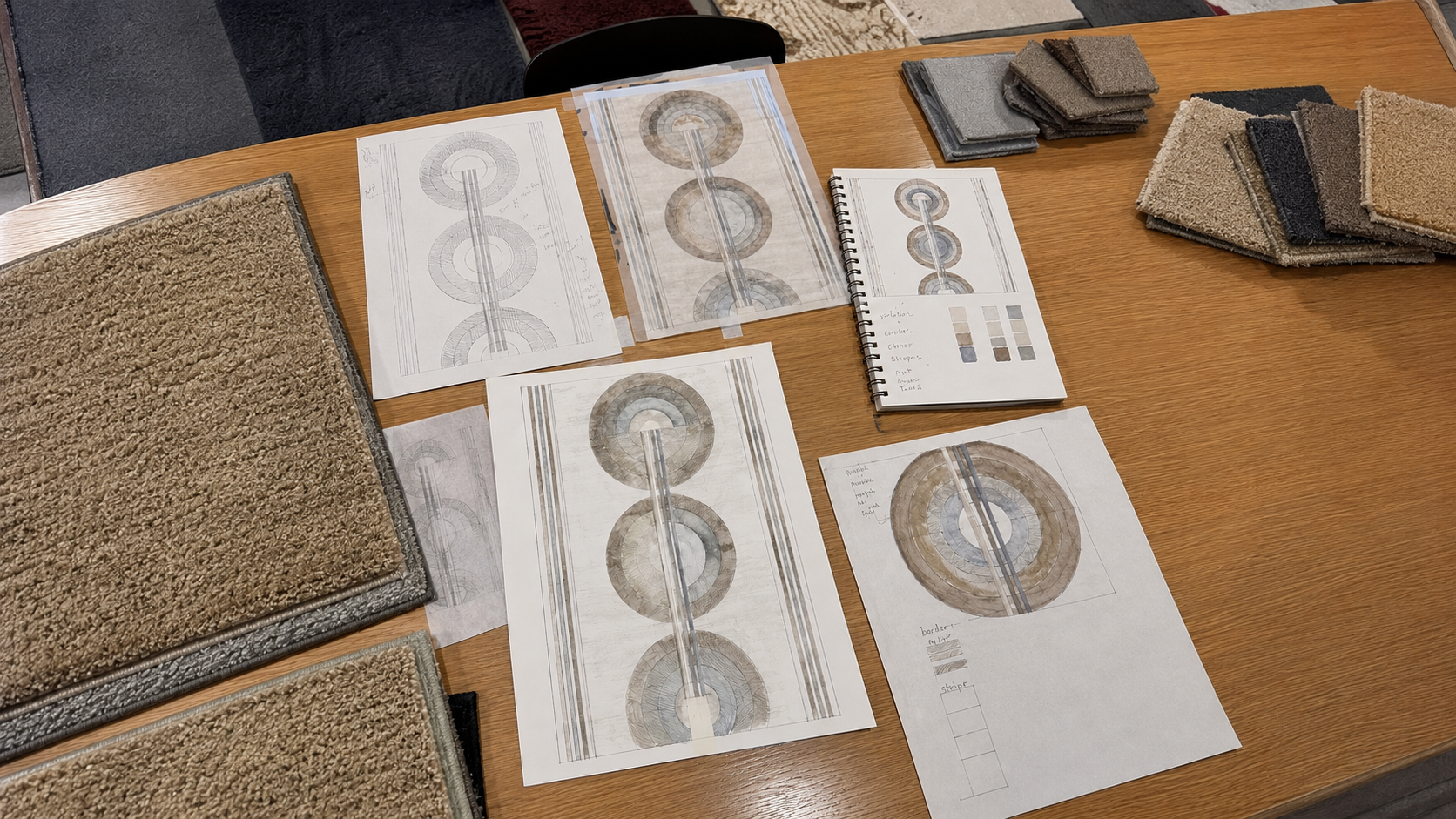
knowledge library / Custom Rug Samples and Strike-Offs: The Approval Guide
A custom rug sample or strike-off is an approval tool, not a miniature promise of the finished rug in every respect. Designers use it to evaluate color, fiber, sheen, texture, pile, relief, pattern scale, and construction before production begins. The most reliable approval process compares the sample with the signed specification, reviews it in the project’s actual lighting, records one consolidated set of comments, and clearly identifies whether the result is approved, approved with noted changes, or requires another revision.
The purpose of sampling is not to eliminate every natural variation in a handmade rug. It is to confirm that the design direction is sufficiently resolved for production and that everyone responsible for approval understands what the sample does—and does not—represent.
What Is a Custom Rug Strike-Off?
A strike-off is a small woven or constructed sample made to test selected elements of a custom rug before the full piece is produced. Depending on the project and the maker’s process, it may be used to review color relationships, fiber combinations, pile height, carving, relief, texture, weave, pattern scale, or a particular technical detail.
A strike-off is usually more informative than a digital rendering because it introduces real material, real light, and real construction. It lets the design team see how colors interact in fiber rather than on a screen, how sheen changes across the surface, and whether a high-low or carved effect reads as intended.
It is still a sample. A small area cannot fully reproduce the way a large rug will read across an entire room, how a repeat will move over a long distance, or how natural handmade variation will appear across the finished piece. Approval should therefore combine the physical sample with the final artwork, dimensions, color references, material specification, and production notes.
Yarn Cards, Poms, Renderings, Samples, and Strike-Offs Serve Different Purposes
Custom rug development may involve several approval materials. The exact terminology and availability can vary, so confirm which tools apply to the specific WOVEN project before relying on them.
| Approval material | What it can help evaluate | What it usually cannot prove on its own |
|---|---|---|
| Yarn card | Individual yarn colors, fiber families, and preliminary palette relationships | Finished pile, density, texture, carving, or the interaction of colors once woven |
| Yarn pom or tuft | Fiber hand, approximate color, luster, and how yarn responds to light | Final construction, pattern clarity, surface density, or full-rug color balance |
| Digital rendering | Layout, crop, orientation, border, repeat, motif scale, and overall color placement | True material color, sheen, pile, texture, or handmade variation |
| Construction sample | Weave, pile, relief, carving, texture, edge treatment, and material interaction | The complete composition or the way a large field will read at room scale |
| Strike-off | A combined review of selected colors, materials, construction, pattern, and finish | Every variation in the final rug or the full visual effect of the completed size |
| Existing reference rug | General precedent for hand, quality, construction, palette, or finish | An exact guarantee when the new rug changes size, color, material, or design |
The approval package becomes stronger when these tools are used together. A rendering may confirm the complete layout while a strike-off confirms the tactile and material direction. Neither should silently replace the other.
What a Strike-Off Should Prove Before Production
A useful strike-off answers specific questions. Before requesting or reviewing one, identify which decisions remain open and which parts of the specification are already fixed.
A strike-off may be intended to confirm:
- The relationship between the principal field color and accent colors
- The appearance of wool, silk, mohair, allo, or another specified fiber
- The amount of sheen and directional color movement
- Pile height and the difference between high and low areas
- Carving, clipping, embossing, or relief
- The clarity of a line, border, motif, or transition
- How a gradient, abrash effect, or tonal field is interpreted
- The selected weave or surface construction
- An edge or finishing detail when included in the sample
Write the purpose of the strike-off into the review notes. A sample intended primarily to approve color should not later be treated as proof of every construction detail unless those details were explicitly included and identified for approval.
What a Small Sample Cannot Fully Predict
The finished rug may be much larger than the strike-off, and scale changes perception. A color that feels dominant in a small sample may become quieter across a large field. A line that appears crisp at sample size may need adjustment when translated to the complete dimensions. Directional fibers may produce more visible shading across a large surface than they do in a small piece.
A sample may not fully predict:
- The room-scale balance of the overall composition
- The exact distribution of natural color or yarn variation
- The visual effect of a large uninterrupted field
- How pile direction will read from every viewpoint
- The final weight, drape, or physical behavior of an oversized rug
- The way the complete rug will interact with furniture and architecture
- Small dimensional variation associated with handmade production
This is why the strike-off should be reviewed beside the final artwork and room plan. The sample answers material questions; the artwork and specification answer composition and dimensional questions.
Can I Customize a Rug's Colors?
Custom rug colors can be developed within the chosen maker's palette, fibers, and construction. Begin with physical references, then approve the color in yarn and in the intended rug surface. A screen image or paint name alone does not establish the finished result. Confirm WOVEN's available color-development options for the selected design before treating a requested match as achievable.
- Set the physical reference. Identify the upholstery, paint, stone, or other material the rug must relate to. State whether the goal is a close match, a warmer or cooler relationship, or a deliberate contrast.
- Review the yarn. Compare the proposed colors in the specified fibers. Label each yarn reference so similar neutrals cannot be confused.
- Check the strike-off. Review color relationships in the intended construction, pile, and proportions. A yarn pom does not show the shadow of a loop or the sheen of a sheared surface.
- Approve in context. Compare the sample with the room materials in daylight and installed lighting, viewed from opposing directions. Record the sample version, any agreed variation, approval date, and approver.
If an ivory sample looks right from one approach and too bright from another, first check pile direction, fiber sheen, and the room's light before requesting a new dye shade. Changing color without checking the surface can solve one view while making another less convincing. Keep color and texture approvals connected in the custom rug specification checklist.
Review Color in Daylight and Installed Lighting
Color approval should never rely on a single photograph or one type of light. Screens shift color, cameras compress tonal differences, and warm or cool lamps can significantly alter the relationship between yarns.
Review the sample in controlled stages:
- Begin in indirect daylight. Use consistent natural light without strong glare or direct sun.
- Move the sample into the project’s installed lighting. Review it under the lamps and color temperatures that will be used in the room.
- Place it beside adjacent finishes. Compare it with flooring, upholstery, stone, wood, paint, plaster, and metal samples.
- Turn the sample. Fibers with directional pile or sheen can appear lighter or darker when viewed from the opposite direction.
- Step back. Close inspection is useful, but the sample should also be viewed from normal standing distance.
- Document the conditions. Record the location, date, lighting, and adjacent materials used for approval.
When comments describe a color concern, avoid vague instructions such as “make it warmer” without a reference. Identify the exact yarn or area, describe the intended change, and provide an approved physical reference whenever possible.
Check Fiber, Sheen, Texture, Pile, Relief, Scale, and Edge
Color often receives the most attention, but construction decisions can change the rug just as significantly. Use a consistent review order so visual and tactile details are not overlooked.
Fiber and sheen
Confirm the specified fiber or blend and observe how it behaves from different angles. A lustrous fiber can make a single color appear to shift across the surface. That movement may be desirable, but it should be understood before approval.
Texture and hand
Touch the sample and assess whether the surface feels as intended: dense or relaxed, smooth or irregular, crisp or soft, flat or dimensional. Compare it with the room’s function rather than judging texture only as an isolated object.
Pile height and relief
Review the difference between high and low areas, the transition between them, and whether the relief is strong enough to read at room scale. Confirm whether carving or clipping creates the intended line quality.
Pattern scale and resolution
Compare the sample with the approved rendering. Confirm which portion of the design is represented and whether narrow lines, small motifs, curves, and gradients translate clearly in the selected construction.
Edges and finishing
If edge treatment is part of the approval sample, inspect its color, width, profile, and relationship to the field. If it is not represented, keep edge approval as a separate documented item before production release.
Use a Written Strike-Off Review Checklist
| Review area | Approval question | Status |
|---|---|---|
| Sample identification | Does the label match the project, design, version, construction, and date? | Approve / Revise / Not shown |
| Color | Are field, accent, border, and transition colors approved under project lighting? | Approve / Revise / Not shown |
| Fiber | Are the fiber content, hand, and luster consistent with the specification? | Approve / Revise / Not shown |
| Construction | Does the weave or knotting method produce the intended surface? | Approve / Revise / Not shown |
| Pile and relief | Are pile height, carving, clipping, and high-low relationships approved? | Approve / Revise / Not shown |
| Pattern | Do line quality, motif scale, crop, and transitions match the approved artwork? | Approve / Revise / Not shown |
| Edge | Is the edge treatment shown and approved, or separately documented? | Approve / Revise / Not shown |
| Open items | Are all exclusions and items not represented by the sample listed clearly? | Complete / Incomplete |
Consolidate Comments Before Sending Them
Sampling can become inefficient when comments arrive from several people in separate emails, marked-up photographs, text messages, and meeting notes. The project team should identify one approval owner and issue one consolidated response for each version.
A strong comment package includes:
- Project name and internal project number
- Rug name or design reference
- Strike-off version and date
- A clear approval status
- Numbered comments tied to annotated photographs or artwork
- Physical color references when a color change is requested
- A list of elements that are approved and should not change
- A list of elements that remain open
- The name and date of the authorized approver
Comments should distinguish between a correction and a new design direction. Replacing an incorrect yarn reference is different from changing the approved palette. Enlarging a motif after sampling is different from correcting its execution. Clear classification helps the team understand what needs to be revised and what other parts of the design may be affected.
Control Versions So the Wrong Sample Is Never Approved
Every rendering, yarn submission, sample, and strike-off should carry a version identifier. Do not rely on phrases such as “the newest one” or “the warmer option.” A simple version system protects the approval chain.
Use identifiers such as:
- Design artwork: A01, A02, A03
- Colorway: C01, C02
- Strike-off: SO-01, SO-02
- Construction option: K01, F01, or another project-approved code
The production-release record should state exactly which artwork version, color reference, strike-off, construction notes, dimensions, and edge details are approved. Superseded files should be marked clearly and removed from the active approval folder.
Follow a Clear Revision and Production-Release Workflow
- Define the sample’s purpose. List the decisions the sample is intended to resolve.
- Confirm the reference package. Align artwork, dimensions, colors, materials, construction, and finish notes.
- Receive and identify the sample. Verify the project name, version, date, and represented details.
- Review in appropriate lighting. Compare the sample with the room finishes and approved references.
- Collect stakeholder comments. Route feedback through the designated approval owner.
- Issue one consolidated response. Mark the sample approved, approved with documented changes, or revise and resubmit.
- Review the revised submission when required. Confirm that requested changes were made without altering previously approved elements.
- Release production in writing. Identify every approved file, sample, dimension, material, finish, and exception.
- Archive the approval set. Keep photographs, marked-up files, emails, and the final release together for reference during production and inspection.
When Is Another Strike-Off Worth Requesting?
Not every comment requires another physical sample, but substantial changes often justify one. The decision should reflect the risk of approving an untested change against the effect that another sampling round may have on the project schedule.
Another strike-off may be appropriate when the revision changes:
- A principal field color or several interacting colors
- The fiber or material blend
- The construction or density
- Pile height, carving, relief, or clipping
- The scale of a motif that depends on construction resolution
- A gradient, abrash treatment, or complex color transition
- An edge detail central to the design
A minor, well-documented correction may sometimes be handled through written production notes, but that determination should be made with the rug maker. Confirm WOVEN’s current sample, revision, fee, deposit, return, and timing policies for the specific project before presenting them to a client.
What Must Be Approved Before Production Begins?
A strike-off approval is only one part of production release. Before the full rug begins, confirm that the complete specification is aligned.
- Final rug dimensions and shape
- Final artwork, crop, repeat, orientation, and border
- Approved color references and yarn selections
- Fiber content and material placement
- Construction, pile, density, texture, and relief
- Edge and end finishing
- Any directional installation requirement
- Accepted handmade tolerances and natural variation
- Approved strike-off version and documented exclusions
- Delivery and project information required for the order
- Written authorization from the designated approval owner
The broader custom process is covered in The Interior Designer’s Guide to Commissioning a Custom Rug. This sampling guide should be used as the focused approval layer within that larger process.
How WOVEN Can Support the Approval Conversation
Studio WOVEN describes a practice built around researching, sketching, designing, coloring, sourcing, sampling, presenting, discussing, and delivering rugs. For a custom project, the design team should confirm the applicable sampling pathway, available submission types, and approval requirements directly with WOVEN before setting client expectations.
Interior designers and architects can also use the WOVEN Trade Portal for project-oriented tools and product information, or contact a WOVEN showroom to discuss a custom rug inquiry. Project-specific fees, deposits, sample returns, revision limits, timing, and production policies should be documented in the proposal or order materials for that project.
Frequently Asked Questions
Can I get a sample before ordering a custom rug?
Sampling may be available as part of a custom rug development process, but the appropriate sample type depends on the project. Confirm availability, fees, deposits, return requirements, and timing with WOVEN before promising a specific submission to a client.
What is the difference between a sample and a strike-off?
“Sample” is a broad term that may refer to yarn, fiber, construction, or a small reference piece. A strike-off is generally a project-specific sample made to evaluate selected design, color, material, and construction decisions before full production.
Does approving a strike-off guarantee that the finished rug will look identical?
No handmade rug will reproduce a small sample as if it were a printed industrial surface. The approved strike-off establishes the accepted direction and quality reference, while the final rug may show natural variation in color, weave, pile, dimensions, and surface movement. The expected tolerances should be documented before production.
How should designers approve rug color?
Review physical material in indirect daylight and in the project’s installed lighting. Compare it with adjacent finishes, view directional pile from more than one angle, and issue comments using named yarns or physical references rather than screen images alone.
How many rounds of strike-offs are typical?
The number of rounds depends on the project, the degree of customization, and the applicable supplier policy. Avoid publishing or promising a fixed number unless WOVEN has approved that policy for the specific project.
Who should sign off on the final strike-off?
The project should have one designated approval owner authorized to consolidate feedback and release production. Client, designer, architect, purchasing, and other stakeholder comments should be resolved before that person issues written approval.
What happens after the strike-off is approved?
The team should complete a written production release that identifies the approved strike-off, artwork, dimensions, colors, materials, construction, edge details, and open exceptions. Sampling approval alone should not substitute for the complete final specification.
The Best Approval Process Is Specific, Visual, and Documented
A strike-off is most valuable when the project team knows exactly what it is reviewing. Treat it as a controlled design decision rather than a general impression. Review it in the right light, compare it with the complete specification, record one set of comments, preserve version history, and release production only when every represented and unrepresented detail is understood.
The result is not the removal of all variation. It is a shared, documented standard that allows a handmade rug to move into production with fewer assumptions and a clearer connection to the room it was designed to complete.