knowledge library / Chinese Art Deco Rugs vs. Traditional Chinese Rugs
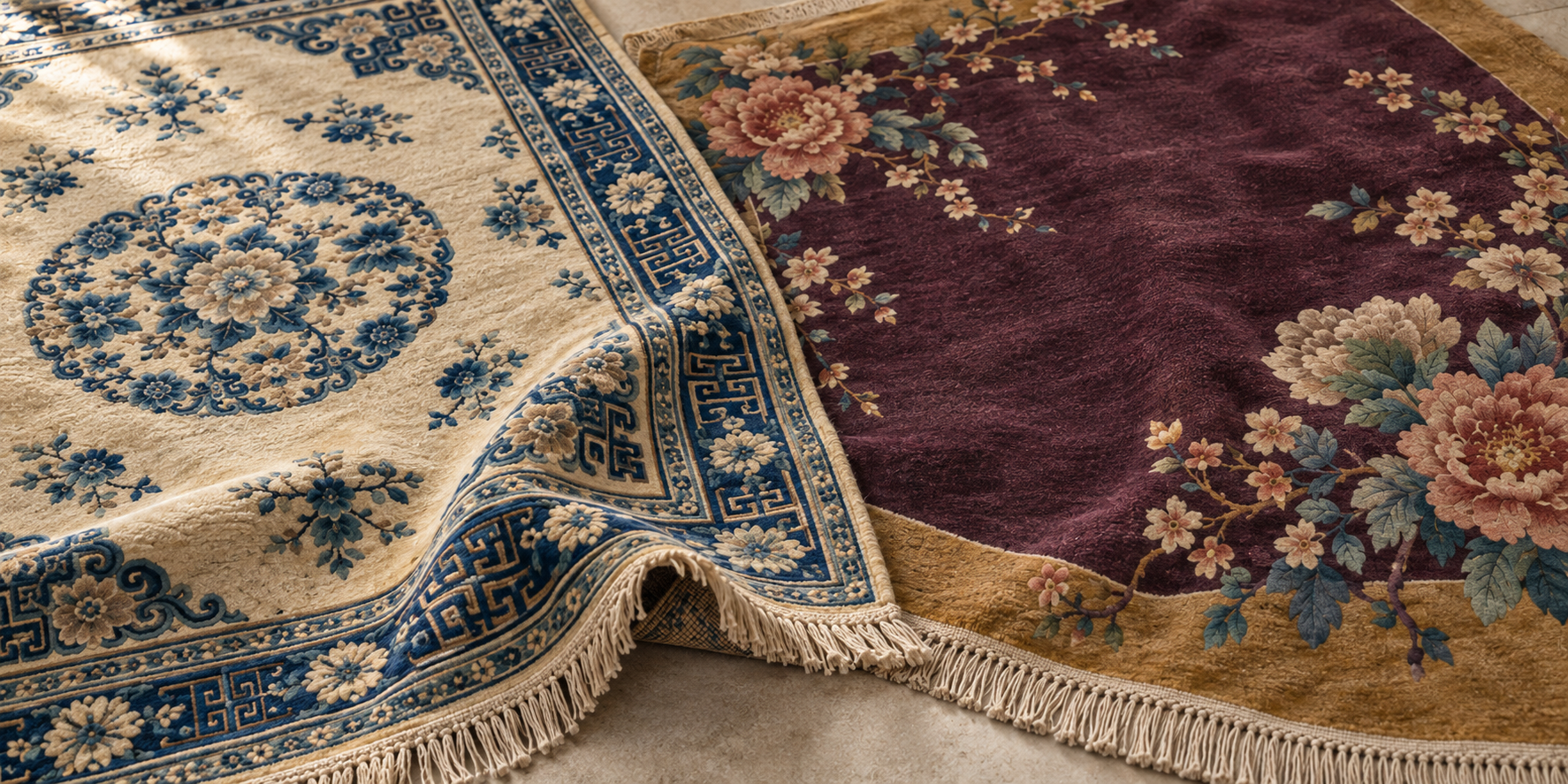
Traditional Chinese rugs generally preserve older, often centered or border-led design systems, while Chinese Art Deco rugs recast Chinese motifs through the bolder scale, asymmetry, open fields, and export-market color of the 1920s and 1930s. The groups can overlap in materials, hand-knotting, and imagery, so no motif, palette, construction detail, or “Nichols-style” label proves the category, maker, or date by itself.
The difference is best understood as continuity and transformation, not Chinese tradition on one side and foreign modernism on the other. Chinese Art Deco rugs were made in China through a modern commercial system that adapted established skills and imagery to new markets and tastes.
What is a traditional Chinese rug?
A traditional Chinese rug is a broad collecting term for carpets that draw on historical Chinese design systems rather than the specifically modern Art Deco export style. The term can encompass different regions, periods, workshops, formats, and uses; it should not be treated as one uniform category.
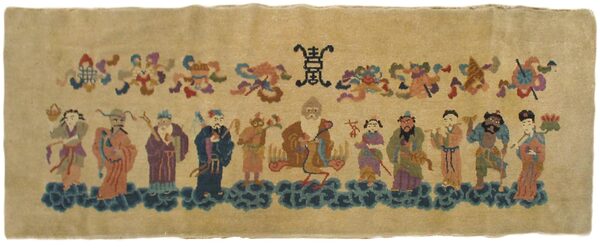
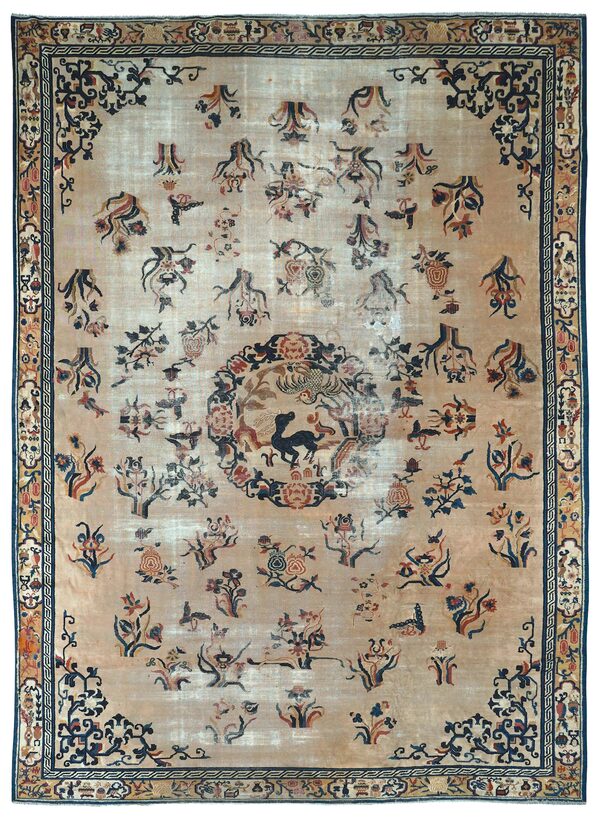
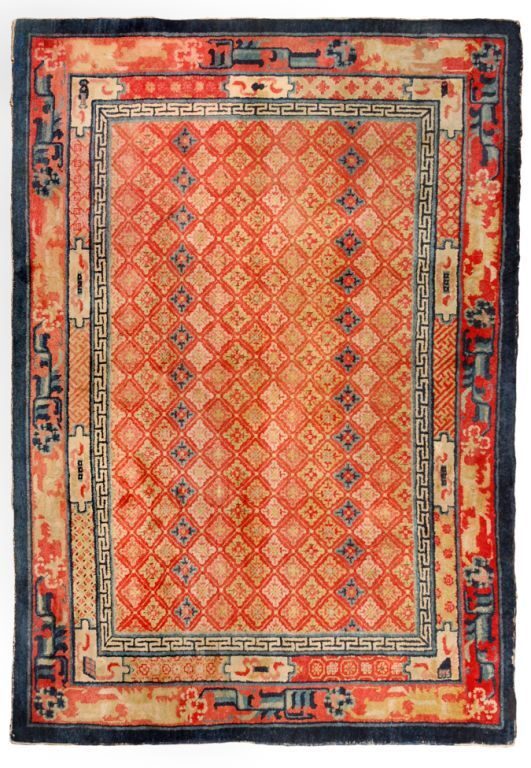
Earlier Chinese carpets may organize dragons, floral forms, cloud bands, fret patterns, auspicious imagery, medallions, corner devices, and borders within balanced compositions. Some are densely patterned, while others use substantial open ground. An eighteenth-century Ningxia carpet and a late nineteenth-century Peking carpet may both be called traditional, yet they need not share the same structure, palette, function, or visual rhythm.
WOVEN's Peking rug collection is one useful category to explore within this larger field. A Peking label, however, should still be tested against the individual rug's date language, materials, construction, drawing, condition, and documentation.
What is a Chinese Art Deco rug?
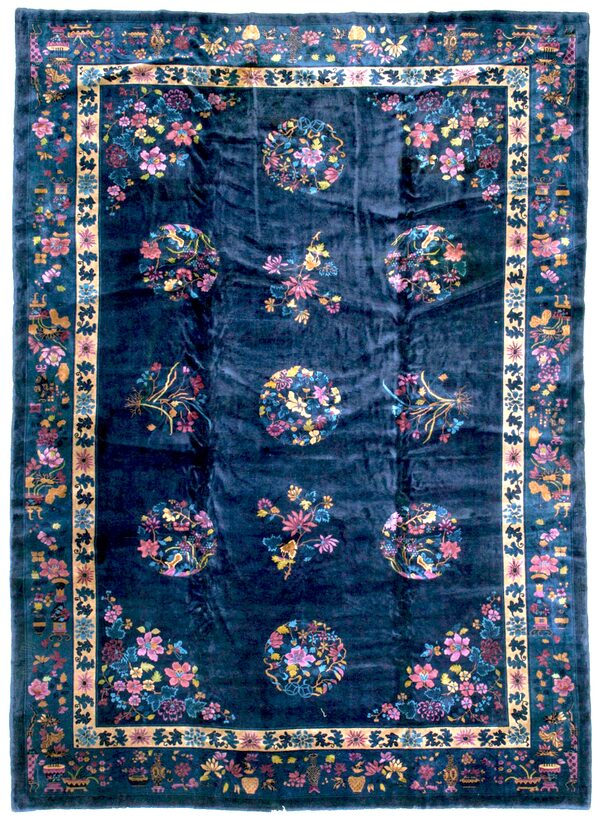
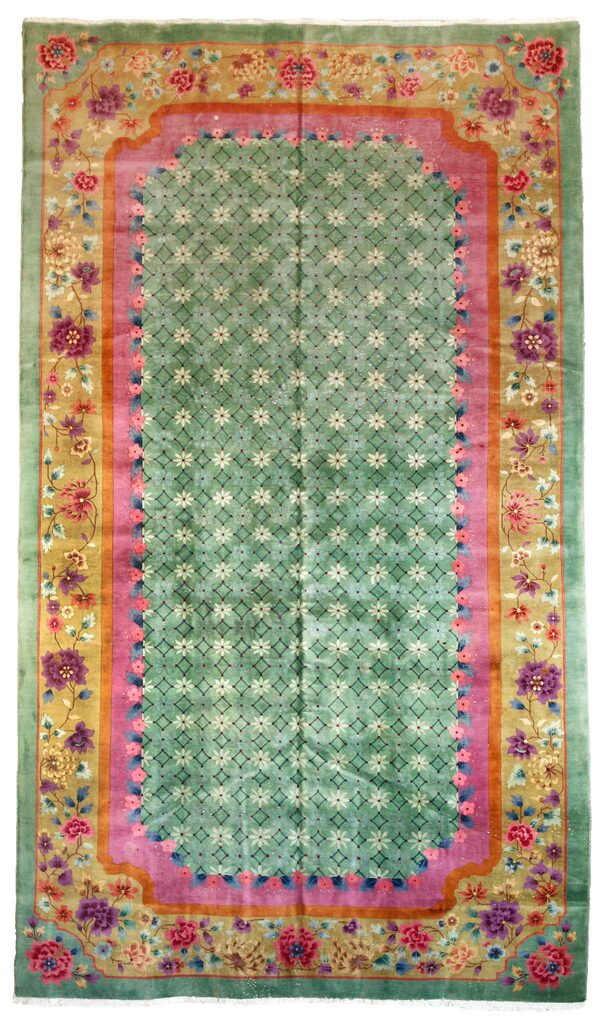
A Chinese Art Deco rug is generally a hand-knotted carpet produced in China, especially through the Beijing and Tianjin export industries, during the 1920s and 1930s or their immediate stylistic orbit. These rugs combined Chinese motifs and weaving knowledge with the enlarged forms, unconventional spacing, saturated palettes, and modern decorative taste associated with international Art Deco.
The category developed within a commercial export system shaped strongly by demand from the United States and other Western markets. Chinese designers, weavers, workshop owners, foreign entrepreneurs, importers, and consumers all participated in that system. Describing the rugs as mere Western designs made in China erases too much; describing them as an unchanged continuation of older Chinese carpets misses the transformation.
Walter Nichols and the Fette-Li company are closely associated with the period, but not every Chinese Art Deco rug was made by either workshop. “Nichols rug” should describe a supported maker attribution, not serve as a generic name for every thick-pile Chinese carpet with bright color and corner flowers.
Chinese Art Deco and traditional Chinese rugs at a glance
The clearest differences appear in design organization and market context rather than one construction test. Each row below describes a tendency, not a rule for every rug.
| Dimension | Traditional Chinese rugs | Chinese Art Deco rugs |
|---|---|---|
| Main period association | Earlier historical traditions, including Qing-era and later nineteenth-century work | Primarily Republican-era production of the 1920s and 1930s, with later examples and revivals requiring separate dating |
| Market context | Domestic, courtly, religious, regional, and export uses varied by place and period | Strongly associated with urban export production and changing Western decorative markets |
| Composition | Often centered, balanced, compartmented, or framed by a legible border system | Often more asymmetrical, edge-weighted, open, or dramatically scaled, though centered examples also exist |
| Motif placement | Motifs may participate in an integrated symbolic or ornamental program | Familiar Chinese motifs may be enlarged, isolated, cropped, clustered, or shifted toward corners and borders |
| Color | Blues, yellows, apricots, reds, neutrals, and softened contrasts appear in many examples, with wide variation | Saturated blue, coral, rose, magenta, green, gold, purple, and dark grounds became prominent, but palettes vary by workshop and rug |
| Spatial effect | Frequently reads through center, border, symmetry, repetition, and measured intervals | Frequently reads through empty field, displaced emphasis, color contrast, and a few large gestures |
| Construction | Hand-knotted pile structures vary by region, period, material, and workshop | Hand-knotted pile is common, but structure alone does not establish Art Deco date or maker |
| Label risk | “Traditional,” “Peking,” and “Ningxia” can become overly broad or inconsistently applied | “Art Deco,” “Nichols,” and “Fette” are often used loosely without sufficient evidence |
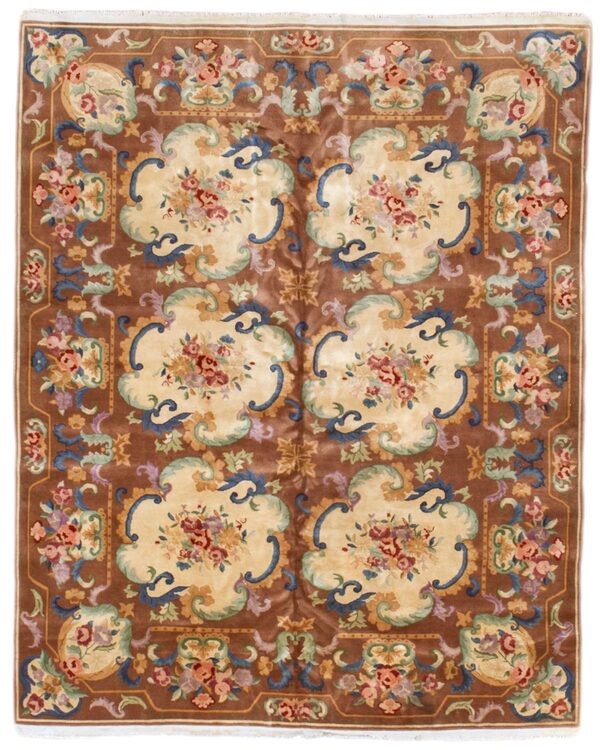
These categories are not sealed compartments. Transitional and export carpets may combine older layouts with newer palettes, while Art Deco rugs may retain central medallions, borders, or established Chinese imagery. When a rug resists the table, describe what is visible before forcing a label.
How did Art Deco change Chinese rug composition?
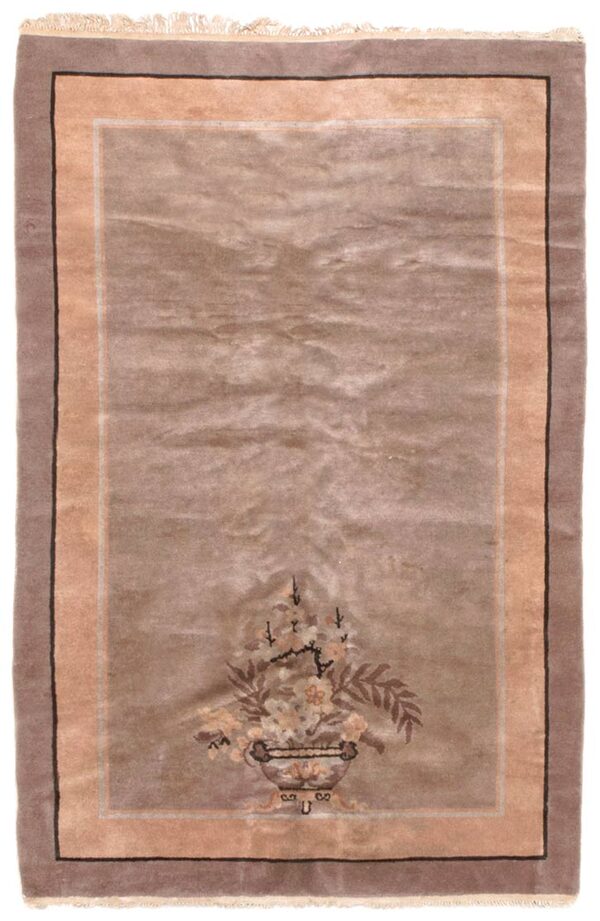
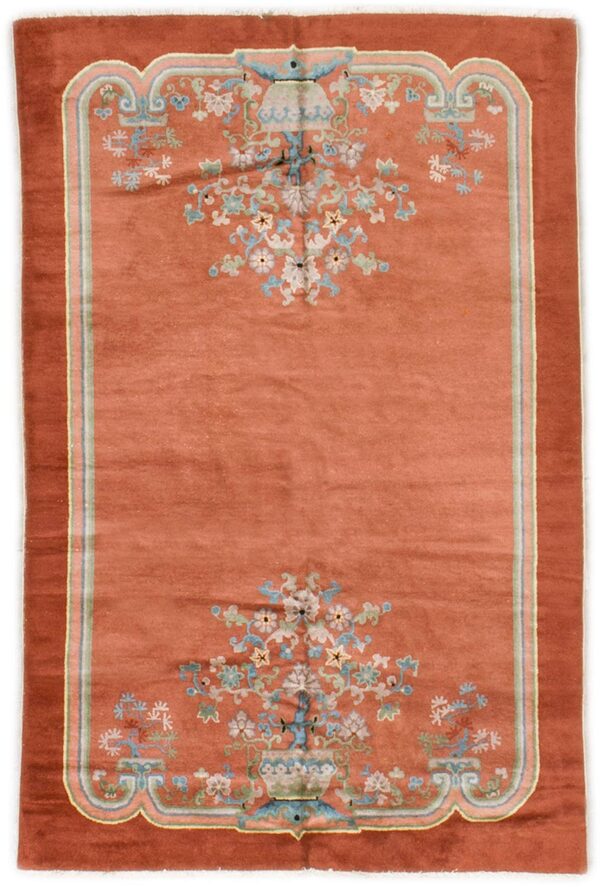
Chinese Art Deco changed composition by altering hierarchy, scale, and placement. Instead of distributing attention evenly through a centered field and border, many Deco designs concentrate visual weight along one edge, in a corner, or around a small number of enlarged floral or geometric forms. Open ground becomes an active part of the design.
At WOVEN, we begin with three questions. Center: does the middle act as the primary focal point, a quiet field, or a passage between edge motifs? Edge: does the border contain the design, or do flowers, branches, clouds, vessels, and geometric devices behave more freely? Empty space: is open ground simply background, or does it control the balance of the rug?
This center-edge-empty-space reading is more reliable than identifying a single peony, vase, cloud, or dragon and assigning the rug immediately. Motifs travel across periods and workshops. Their scale, relationship, and position often reveal the design system more clearly than their presence alone.
Which motifs continue across both groups?
Many motifs continue across traditional and Art Deco Chinese rugs, but their visual roles change. Flowers, flowering branches, birds, butterflies, dragons, clouds, vessels, fretwork, roundels, and other auspicious or decorative forms can appear in both groups. Continuity of imagery does not mean continuity of meaning, composition, market, or date.
In an older balanced layout, a motif may belong to a repeating field, central medallion, corner system, or carefully ordered border. In an Art Deco rug, a related form may be enlarged into a sweeping corner spray, isolated against a broad color field, paired with a geometric frame, or cropped by the edge. The newer design may preserve recognition while changing the experience of scale and movement.
Symbolic interpretation requires restraint. The meaning of a bat, lotus, dragon, fret, or longevity character depends on the form, context, date, and cultural program. A generic symbolism list cannot authenticate a rug or explain every use of a motif.
Are Chinese Art Deco rugs always brighter?
Chinese Art Deco rugs are often associated with assertive, unusual color combinations, but brightness is not a conclusive test. Traditional Chinese carpets also use distinctive blues, yellows, reds, apricots, browns, and neutrals, while some Art Deco rugs are restrained or pastel rather than saturated.
Read color as a hierarchy. Identify the field color, border or edge color, dominant motif colors, and small accents. Then ask whether color creates symmetry, disperses attention, or pulls the eye toward an offset cluster. Art Deco effect often comes from the relationship between a large uninterrupted field and concentrated color, not from brightness alone.
Fading, washing, chemical treatment, soiling, repair, photography, and lighting can all alter appearance. A bold palette does not prove synthetic dye, 1920s production, a particular workshop, or authenticity; a softened palette does not prove age or natural dyes. Dye identification may require technical analysis when the conclusion matters.
Can construction distinguish the two categories?
Construction can support a Chinese rug attribution, but it rarely separates traditional and Art Deco examples by itself. Both groups may use hand-knotted wool pile on a woven foundation, and workshop practices changed across time, location, and intended market.
Inspect the reverse, knot structure, warp and weft, yarn character, pile height, side and end finishes, dimensions, handle, and any labels or marks. Map whether the structure remains consistent across the rug. Repairs, reweaving, reduced ends, replaced fringes, overcasting, washing, and backing can obscure or alter useful evidence.
Avoid universal shortcuts. No fixed yarn-ply count, knot type, pile depth, fringe treatment, or handle proves that a rug is traditional Chinese, Peking, Ningxia, Art Deco, Nichols, or Fette-Li. Construction should agree with chronology, design, documentation, and condition before it carries interpretive weight.
How should a designer choose between them?
A designer should choose between traditional Chinese and Chinese Art Deco rugs by the visual role the room needs, then confirm the individual object's condition and scale. Neither category is inherently more formal, modern, versatile, or valuable.
Traditional layouts can reinforce a centered furniture plan, architectural symmetry, or a room that benefits from measured borders and distributed ornament. Chinese Art Deco rugs can work as a counterpoint in quiet architecture, introduce concentrated color beneath restrained furniture, or animate an off-center composition through edge-weighted motifs and open ground.
View the rug from the room entrance, the principal furniture group, and close range. From the entrance, read the overall hierarchy. Within the furniture plan, note which motifs disappear and which remain visible. Close up, examine color transitions, line quality, pile, wear, repairs, and finishing. A successful choice remains coherent at all three distances.
Readers can explore WOVEN's broader Chinese rug collection and antique Chinese category to compare actual compositions. For a contemporary WOVEN interpretation of 1920s geometry rather than an antique Chinese attribution, the Elysian collection offers a separate design reference.
What are the most common labeling mistakes?
The most common mistake is treating “traditional Chinese” as a precise origin, period, or quality grade. It is an umbrella that must be narrowed through evidence. A second is calling every Chinese Art Deco rug a Nichols rug, even when no signature, label, documentation, or convincing specialist attribution supports the maker.
Other recurring mistakes include:
- assuming asymmetry always means Art Deco;
- treating a central medallion as proof of an earlier traditional date;
- using palette alone to identify dye source or decade;
- reading wear, fading, or thick pile as proof of age;
- interpreting Chinese imagery through a fixed universal symbolism key;
- assuming handmade construction establishes quality, condition, rarity, provenance, or value.
Precise cataloging may still end with a range: for example, Chinese, early twentieth century, Art Deco taste, workshop unconfirmed. Calibrated language is more useful than an impressive attribution that outruns the evidence.
A seven-step WOVEN framework for comparing Chinese rugs
A responsible comparison moves from broad classification to object-level evidence:
- Define the label. Ask what the seller or catalog means by traditional, Peking, Ningxia, Art Deco, Nichols, or Fette-Li.
- Establish a date range. Separate a documented date from circa language, style-based dating, and unsupported assertion.
- Read center, edge, and empty space. Identify the composition before interpreting individual motifs.
- Map continuity and transformation. Note which Chinese forms remain and how scale, placement, color, or geometry changes them.
- Inspect construction and condition. Compare front, reverse, pile, foundation, sides, ends, repairs, and alterations.
- Review documentation. Look for labels, signatures, photographs, invoices, collection history, publications, and comparable objects, while testing whether each record truly belongs to the rug.
- State confidence honestly. Keep design family, geographic attribution, workshop, date, condition, authenticity, and value as separate conclusions.
Chinese Art Deco rugs are not simply brighter versions of traditional Chinese carpets. They are modern Chinese export objects in which inherited motifs, workshop knowledge, international design, and commercial demand were reorganized into a new visual language. The most useful comparison recognizes that transformation while allowing each rug to complicate the category through its own composition, structure, condition, and evidence.